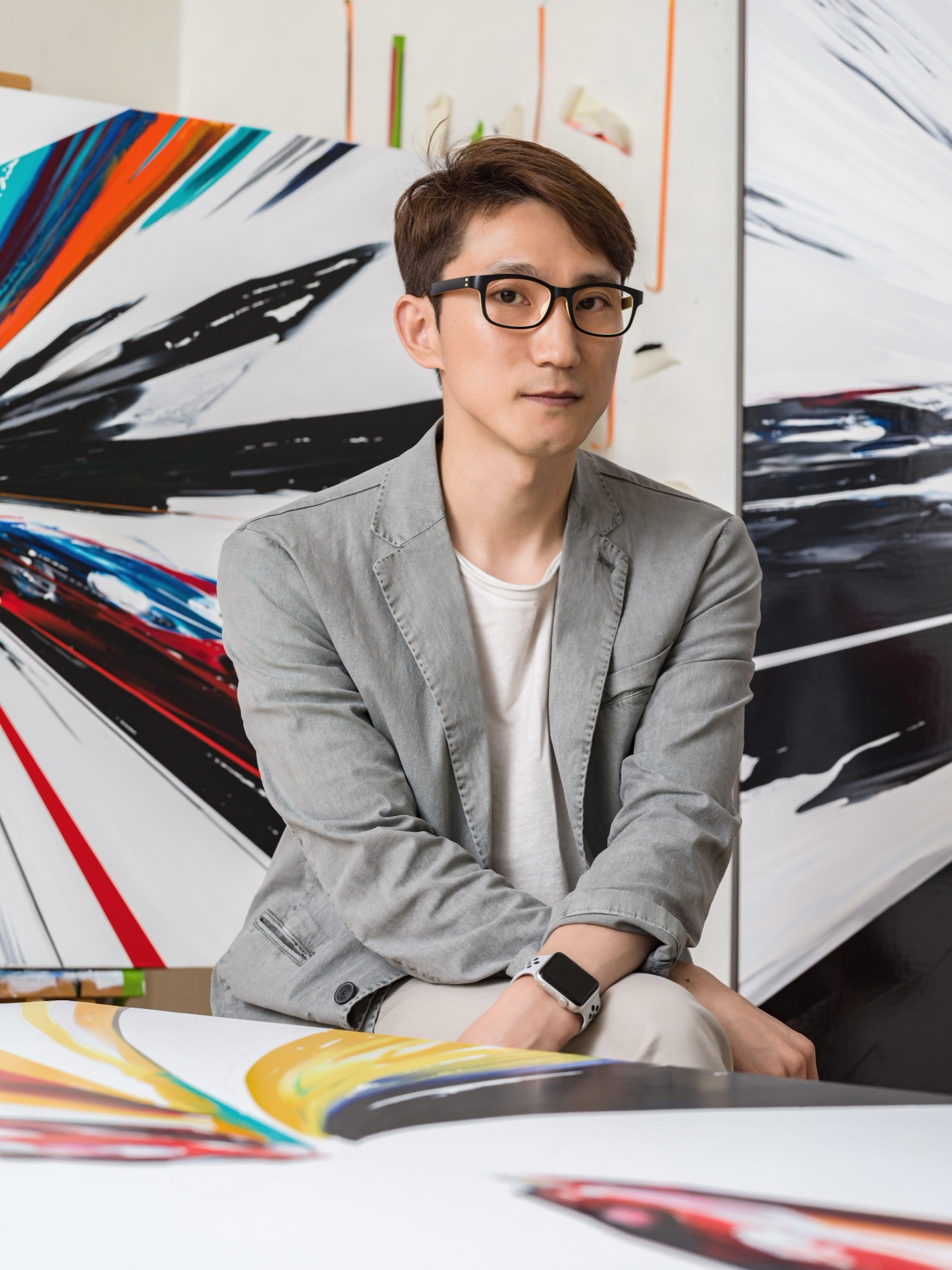
강민석 · Minseok Kang
Automotive Fine Art자동차 회화
A portrait of the contemporary human, painted in speed
I am a painter who paints cars.
But on my canvas, a car has never once been a machine. It runs, sways, loses its way, and comes to a stop in my place — I borrow the form of the car to paint the human being.
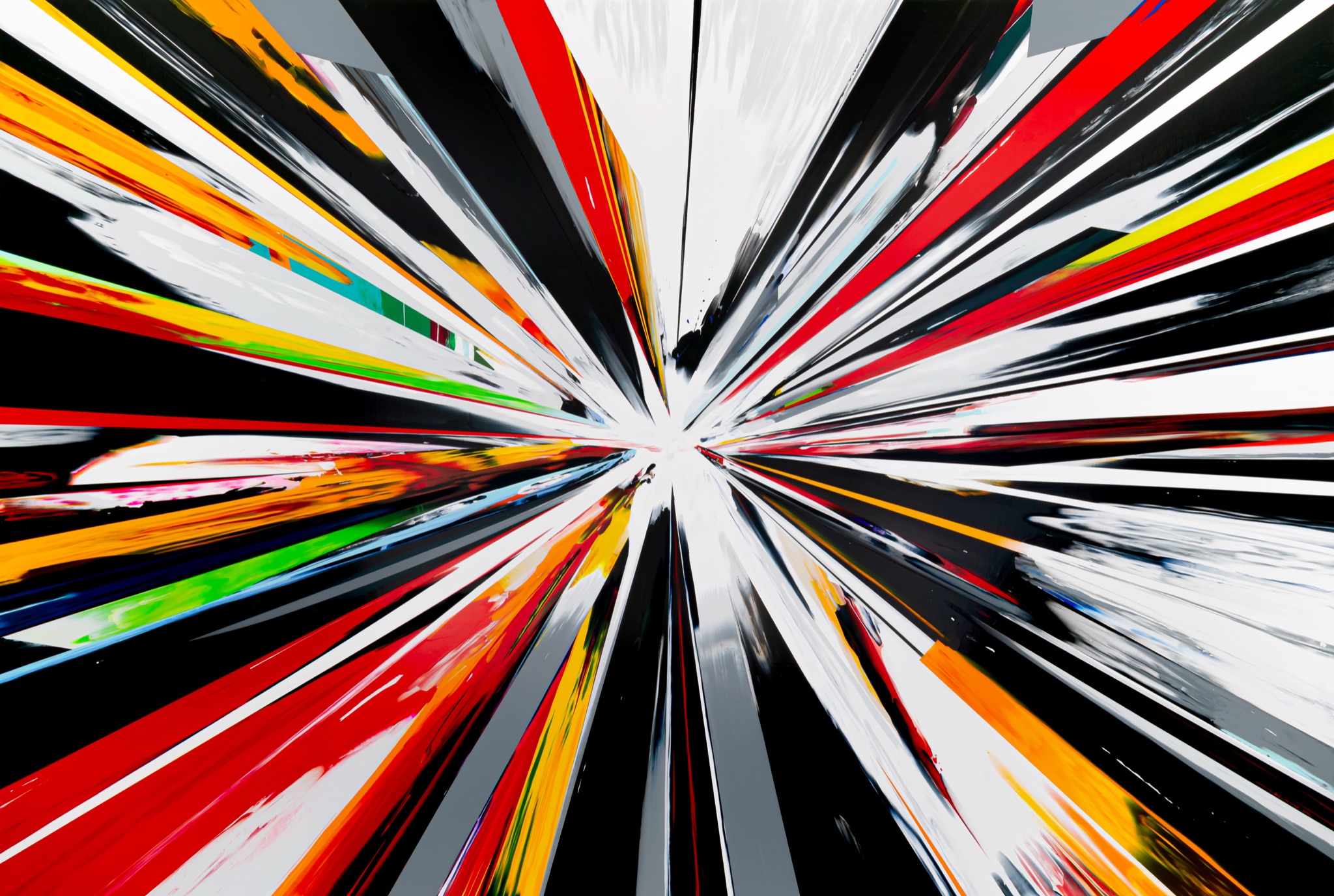
Each time the car's form warps and comes apart, I ask a different question: the identity of those racing through an age of speed, the change that never stops, the new turn that takes place on the boundary between figuration and abstraction. A collapsing form is not destruction but growth — through this single form I look at time, the inner world, and the many faces of existence.
I have drawn since I was a child. I never had a dream other than becoming a painter. Through the entrance exams my hands grew free, and I studied Western painting at Dong-A University. I did not like putting myself forward. I was an introverted child. Painting was the only way I spoke to the world.
Around that time I was painting the city in abstraction. One day, in a corner of the canvas, I collaged a small image of a car. It was an accident. That was the beginning. On the streets there were always cars. They were going somewhere, stopping, moving by the rules. I began to see them a little differently. A car has direction. Speed and racing hold time within them. The landscape beyond the body of the car speaks of environment and space. And the car was a being stronger than I was. Its form was beautiful; its icon was powerful. Instead of painting that being realistically, I borrowed it and began to speak of the force within — of myself. And I have been speaking ever since. I did not have to step forward in person. Before I knew it, I had fallen into a life of competition. Competing through painting with rivals whose faces I did not know. It was a time before social media. Among people of strong individuality, I often lost my sense of presence. When my own being grew faint, I needed an object — even a meaningless one. I needed some kind of achievement. At the time, that was my way through. Passing through those years, the car became, more and more, my own story. A car passes through a tunnel and crosses into a new space. Like a dream. Because it changes.
I have failed many times. So I am always afraid. I hate mistakes, so I am careful, and careful again. And still the mistakes and failures repeated. To avoid them I revised digitally, dozens of times, looking at the work every day, imagining. The mistakes did not lessen. I came to think the answer was mine to decide. It was my own stubbornness. Traces only I could see kept piling up, and at some point I arrived where I could no longer paint. A deep depression came. To pass through it, I began to run. Running raised my body, and my body raised my mind. That force began to erupt in the paintings. Forms condensed almost beyond recognition — an explosion of the inner world. From then on I began to speak with my inner self in earnest. Accepting, compromising, moving on to the next stage.
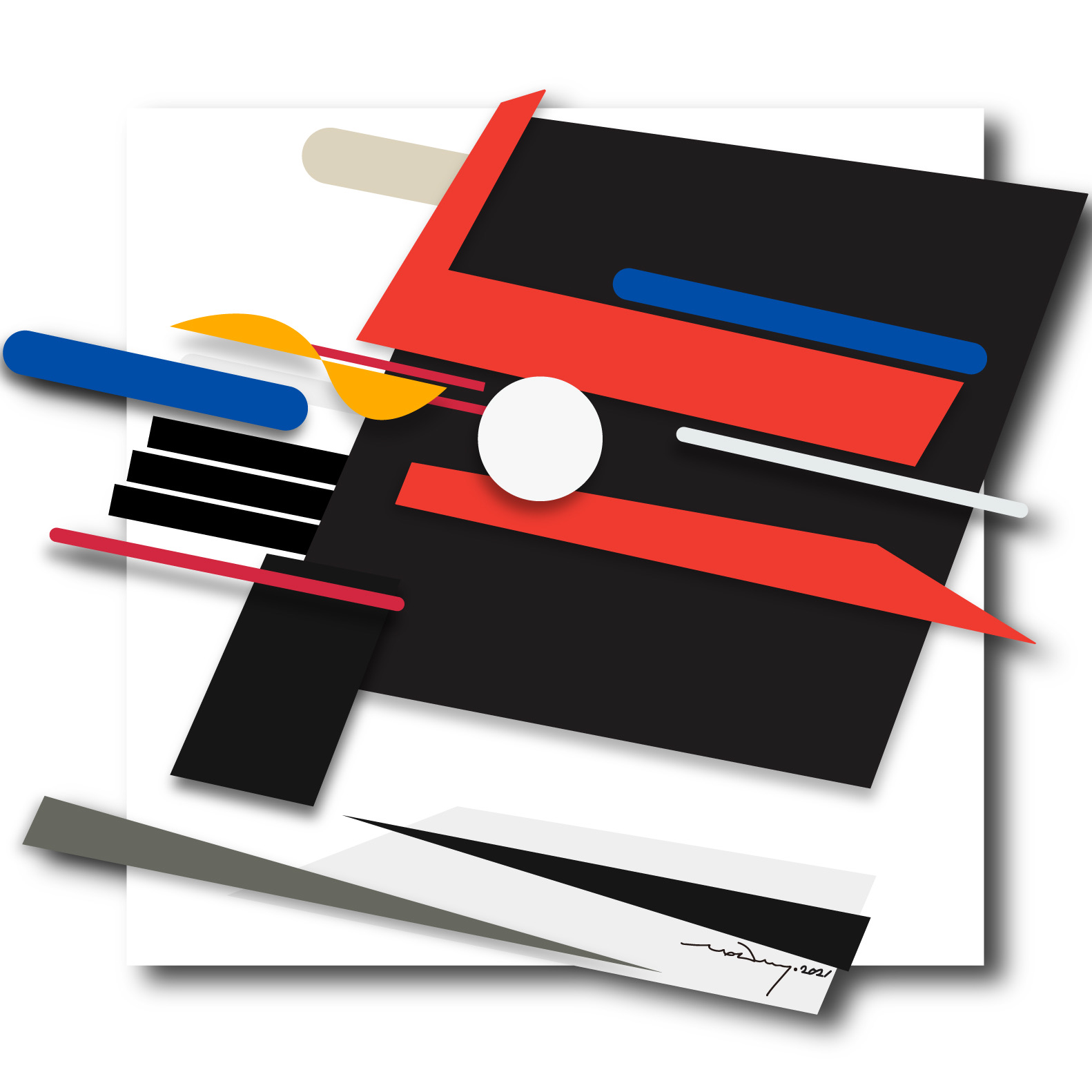
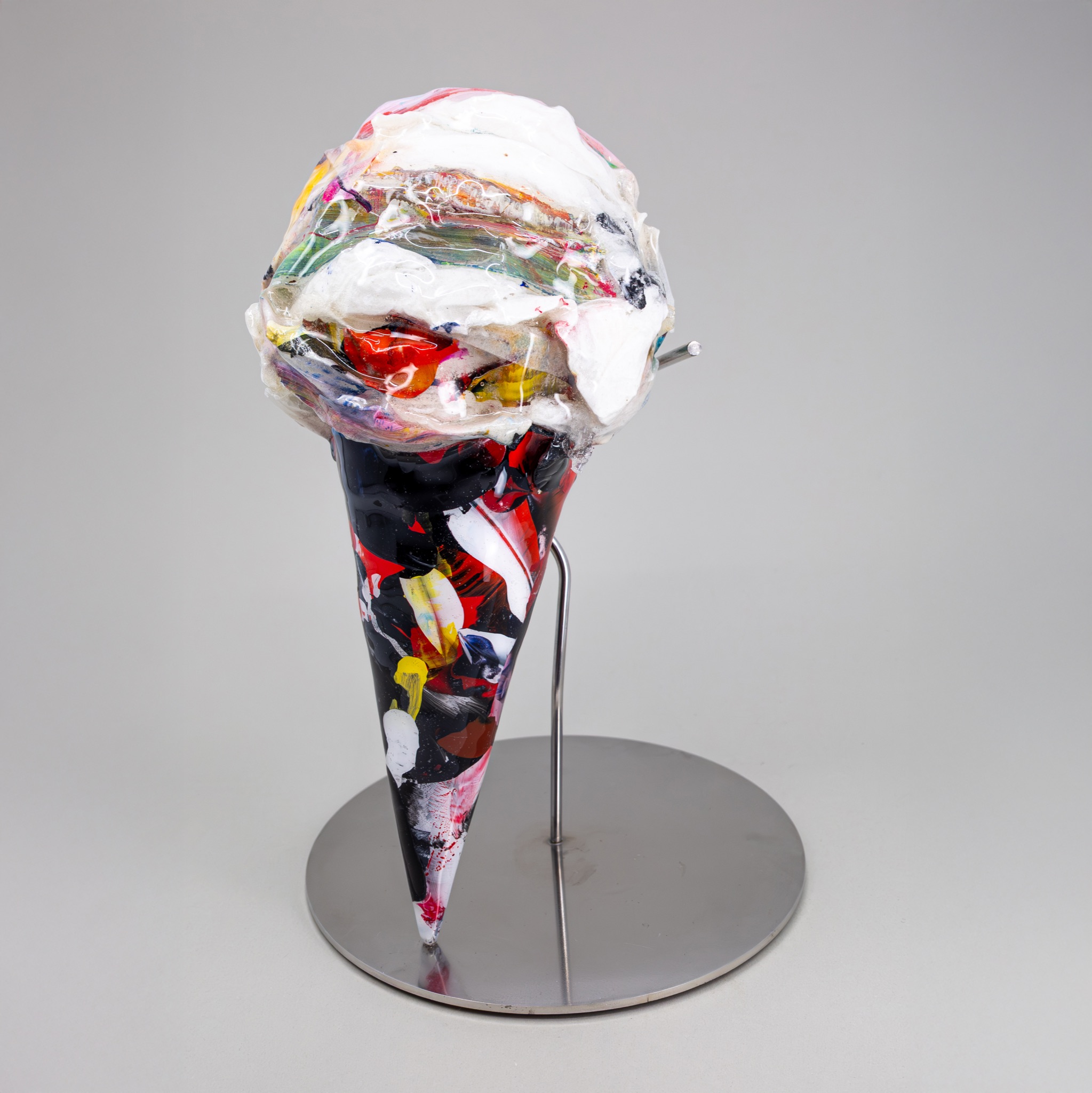
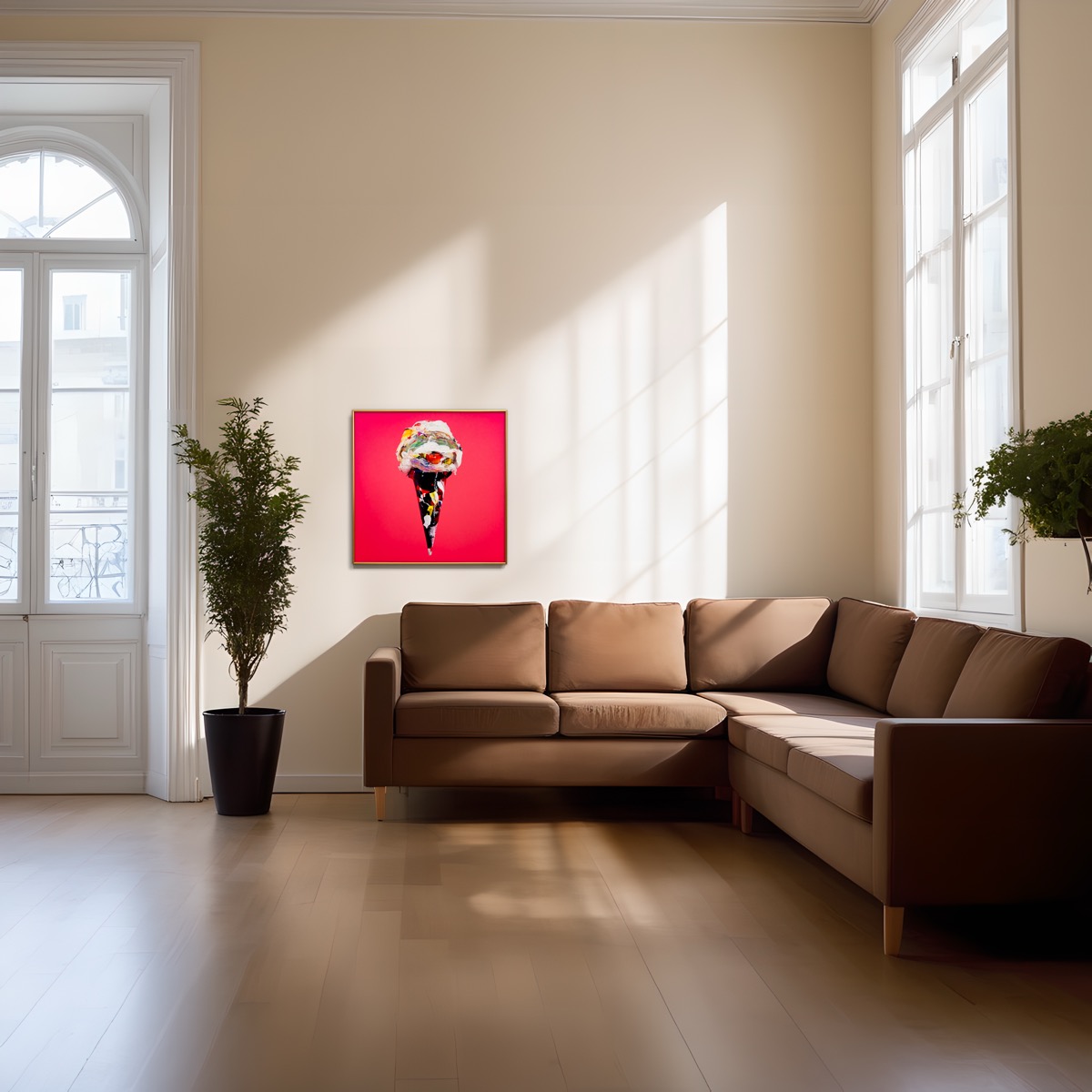
Technique is made to seep into the painting. When skill steps forward, the story is buried. I paint the car, yet I distort its form, or seize only its beauty. There are no rules about material. Pushing paint with a squeegee, I may at any moment pick up a brush, sew in thread, or attach an object. The ice cream sculptures and the media art, too, were projects I planned with concept and philosophy, in media I could absorb from my time. If there is a strong stem reaching toward an ideal, then the desert, the stray racer, and the overturned cloth are the fine roots grown between — sometimes connecting, sometimes scattering.
My paintings are interlocked with the lives of contemporary people. Competition and success, failure, rage, identity, dreams. I am only speaking through the mask of the car. That form, dense with brilliant and violent force, is the condensed true self that lives inside every one of us. My paintings do not console. Color and form, explosion, rage — an intense condensation of the inner world. That is why they reach the viewer through the medium of painting, and why, for someone, they become strength.
I hold a solo exhibition every two years. Competition is now a conversation with myself. I believe the answer is not arriving somewhere, but a life I can sustain. When I reach a limit, I look for a way through. Not accepting this as fate and living on — but searching for the answer of a greater ideal.
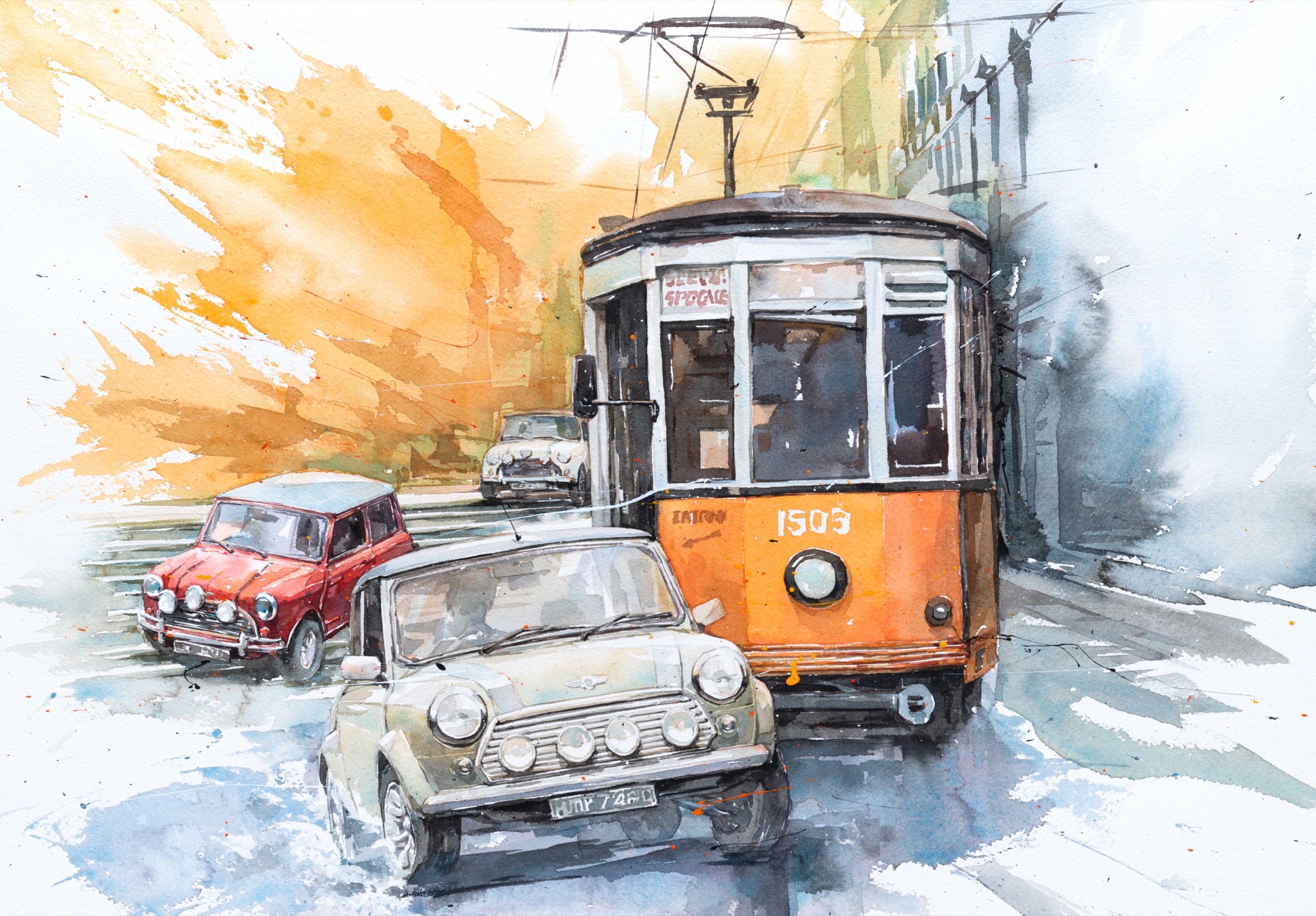
From acrylic pushed with a squeegee, to time sewn in thread, to inner worlds painted on the raw back of overturned cloth, to classic cars in watercolor — the series below are the record of one question evolving into different faces over the years. The starting point of every story is myself. Each series opens onto the works and my notes; the essay series ⟨Reading MINSEOK⟩ reads this world in depth.
Original PaintingThe Artist's Thoughts
- You paint cars, and yet to call this simply 'automobile painting' feels like it misses something. How would you introduce your work?
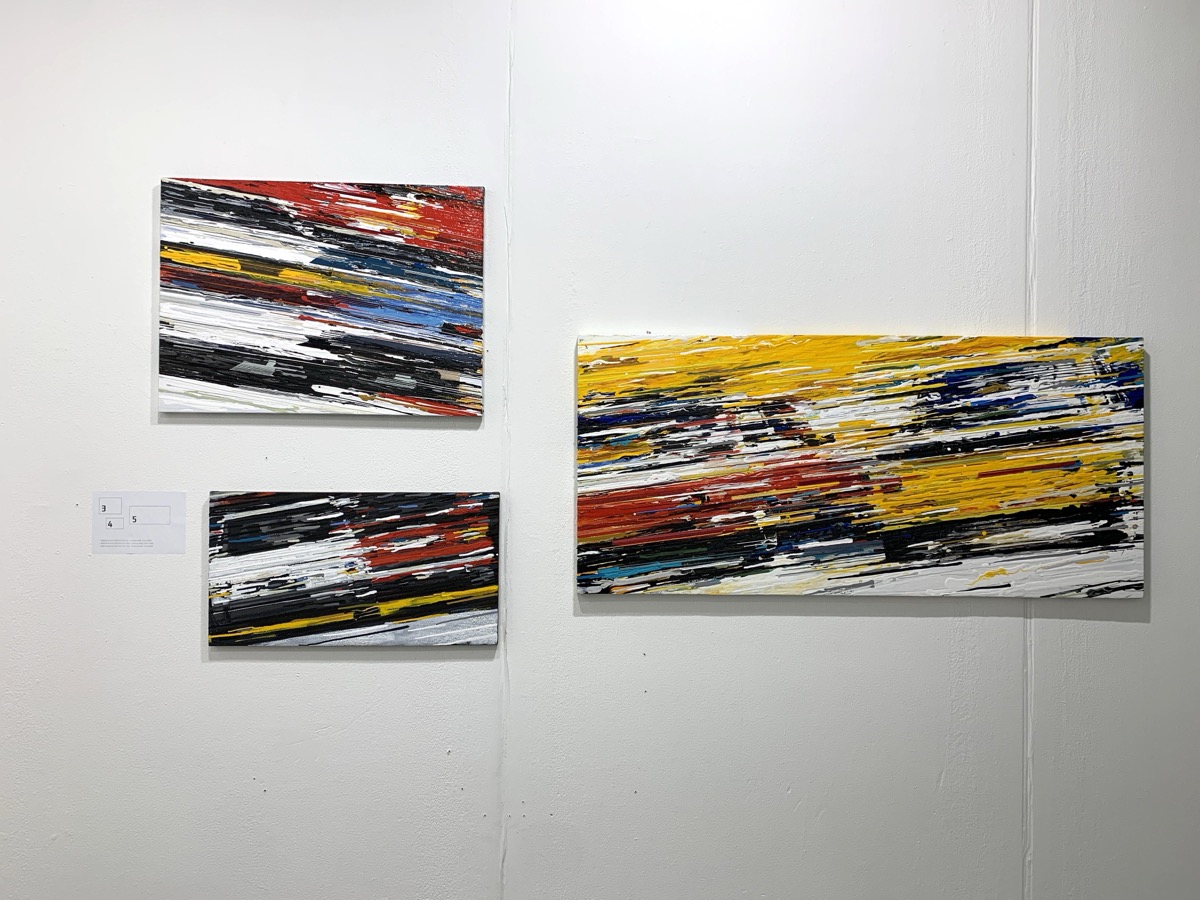
- I paint cars, but what I'm trying to say on the canvas has never once been the car. What I'm after is speed — and by speed I don't mean the sensation of going fast, I mean time. When I push paint across the surface with a squeegee, what remains is not the distance travelled but the trace of time that has already passed. So what stays on the surface is not the car but time itself. The form of automobile painting is only borrowed; what I'm really painting is a person living their way through that speed.
- Then why the car, of all things? There are so many other subjects — was there a reason it had to be the automobile?
- There is an instinct in the automobile: a force that wants only to press forward, an impulse to race that knows no way to stop, a kind of blindness that never asks where it's going and throws itself into speed for its own sake. I set that mechanical instinct right in front of our inner life. Inside us too there is an urge that keeps driving us forward, and at the same time an anxiety that doesn't know where all that racing is headed — for me, the work is the single event in which those two collide head-on. So the car is not really my subject; it is closer to a mirror, reflecting the struggle a person wages with the speed inside themselves.
- Because you work with speed and the automobile, some might think of early-20th-century Futurism. How is your work different from Futurism?
- On the surface they may look alike, but they face in opposite directions. Futurism glorified the machine and speed — it believed that the faster thing was the more beautiful. I stand on the other side. This age already commands us to go 'faster,' and I refuse to worship that speed — yet I don't smash it either. I pass through speed to recover what it has erased: the human inner life, and the time we've moved through. So when form dissolves on my canvas, it is not destruction but revelation. If Futurism was a hymn to the machine, mine is closer to a counter-current — an attempt to recover the human in the very midst of the race.
- Your method is unusual. Rather than a brush, you scrape the paint with a squeegee. In the studio, what does that moment actually feel like?
- The moment I drive acrylic paint across the surface with a squeegee is always a little chilling, because once it passes there is no taking it back. Sometimes a color I laid down earlier glimmers faintly up through the place I've just scraped, and those accumulated layers are what I call 'memory.' In the resistance of the paint at my fingertips, in that brief tension that is over in an instant, an entire span of time — something passing through and then vanishing — is pressed flat. So before I draw a single stroke I hesitate for a long while, and once it's drawn I stand and study the mark just as long.
- Your work seems to keep changing as time passes. Only two years ago you were laying embroidery thread over the canvas, and now you've stripped even that away, painting with the squeegee alone. Why do you keep taking things away?
- My work evolves and changes ceaselessly, along with its times — and that change itself is what I'm trying to paint. There was a time I laid down lines of rule and relationship with embroidery thread, but now I've removed even that and push the surface with the squeegee alone, because the more I strip away, the more honest it feels. To me a painting is the span of time where the clock of my own searching hangs. As I grow older my thoughts shift; they compromise, they persuade, they collide and cross one another. Within that there is still the fear of challenging something new, and the many pains of passing through that fear. I don't hide that unsteadiness — I leave it on the surface. How a single person changes within time: in the end, that is what my painting is telling.
- Your work increasingly lets the form break down, moving toward an abstraction where the car is hard to make out. Why deliberately dismantle the image? And in that place, what does the viewer come to see?
- For me, distortion is not destruction but growth. I believe that identity is forged precisely at the point where form collapses. The sharper the car's outline, the more people stop at 'ah, that's a car' — but the more the image scatters, the more the viewer begins to look not at the painting but at themselves. When it isn't clear what has been depicted, people draw their own experiences and anxieties into that empty space and fill it. I believe the face that surfaces this way is, in the end, a portrait of the contemporary human — the inner life of all of us, straining not to lose ourselves inside a speed that drives us relentlessly forward.
- Finally, where can those who want to encounter your work in person find it? And at the end of all this racing, what is the question you ultimately leave us with?
- The original works only reveal themselves once the thickness of the paint layers stands directly before you, so anyone genuinely curious about the actual pieces is best to reach out by email. The originals also meet collectors around the world through international art platforms such as Artsper, Saatchi Art, Singulart and Artmajeur. And for those who love cars, I've built a separate poster brand registered as a trademark, MINSEOK® — my watercolor car works turned into art posters, available on Amazon in the United States, Canada, the United Kingdom and Germany. Whatever form the encounter takes, what I hope for is one thing — that you pause before it for a moment and look back at the speed within you and the time that speed has passed through. The machine never stops; it only races forward. The human, though, is a being who, in the very midst of that speed, asks again: what on earth am I? In the end, my work is — from first to last — a scraping and layering toward that single question: what is a human being?