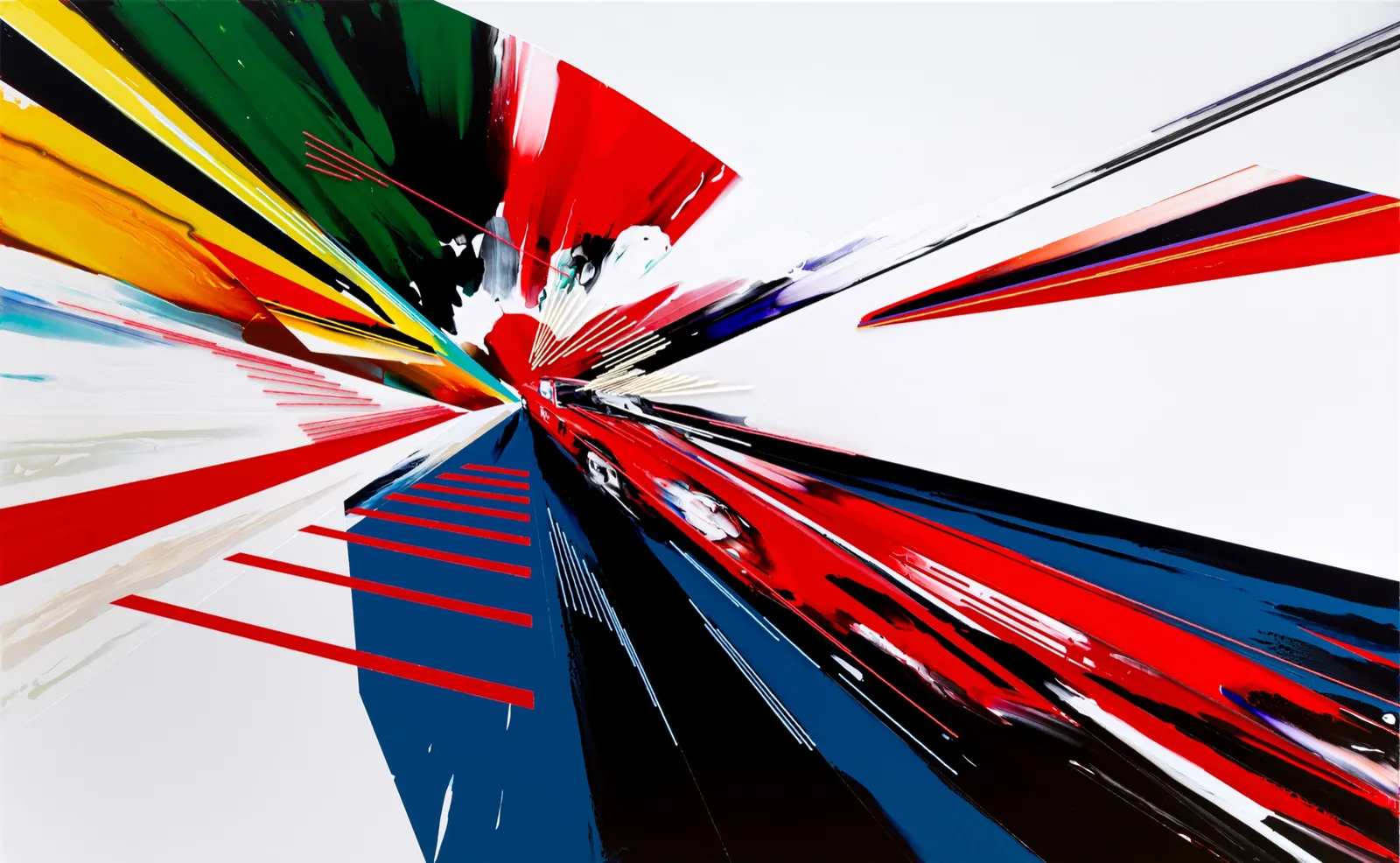
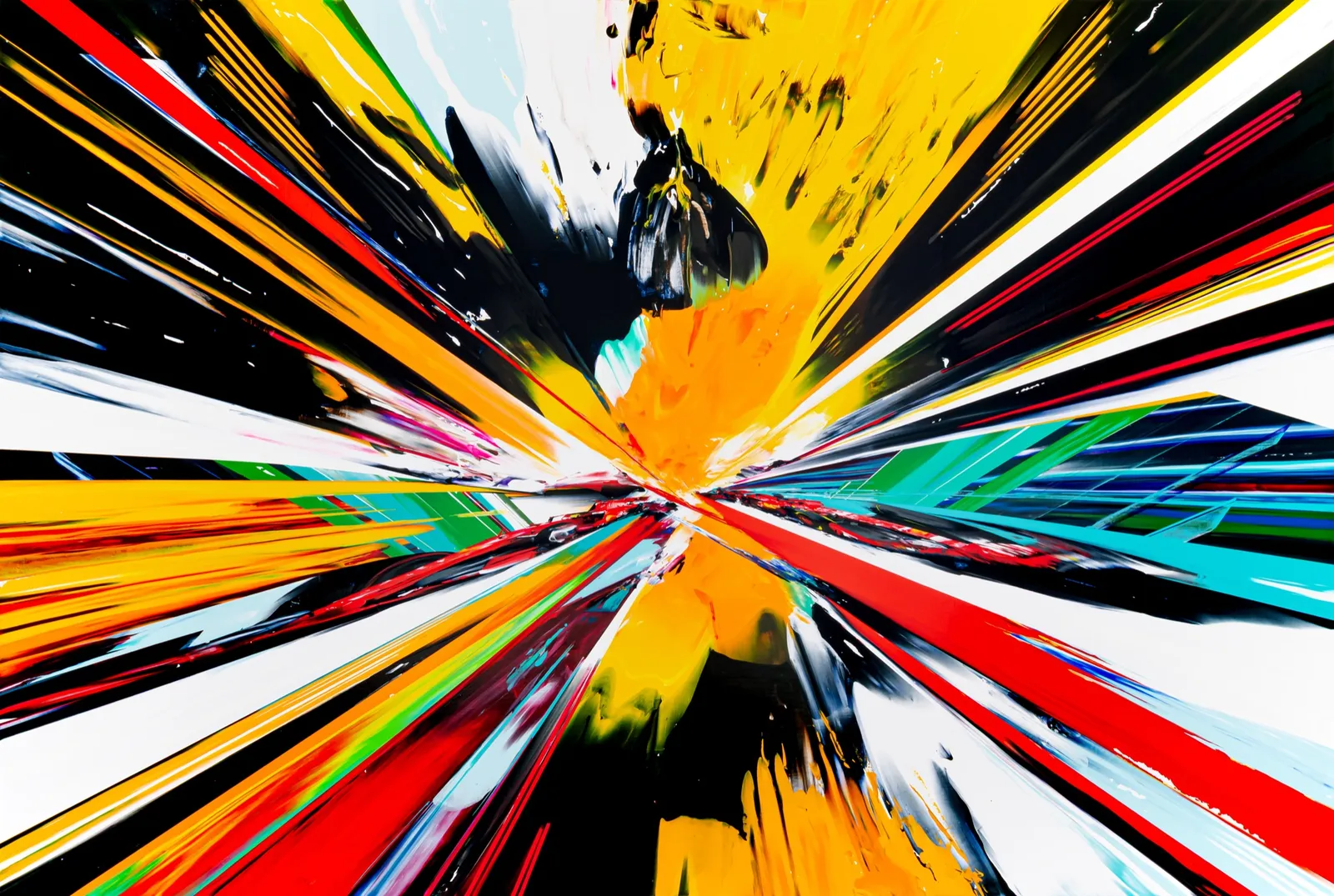
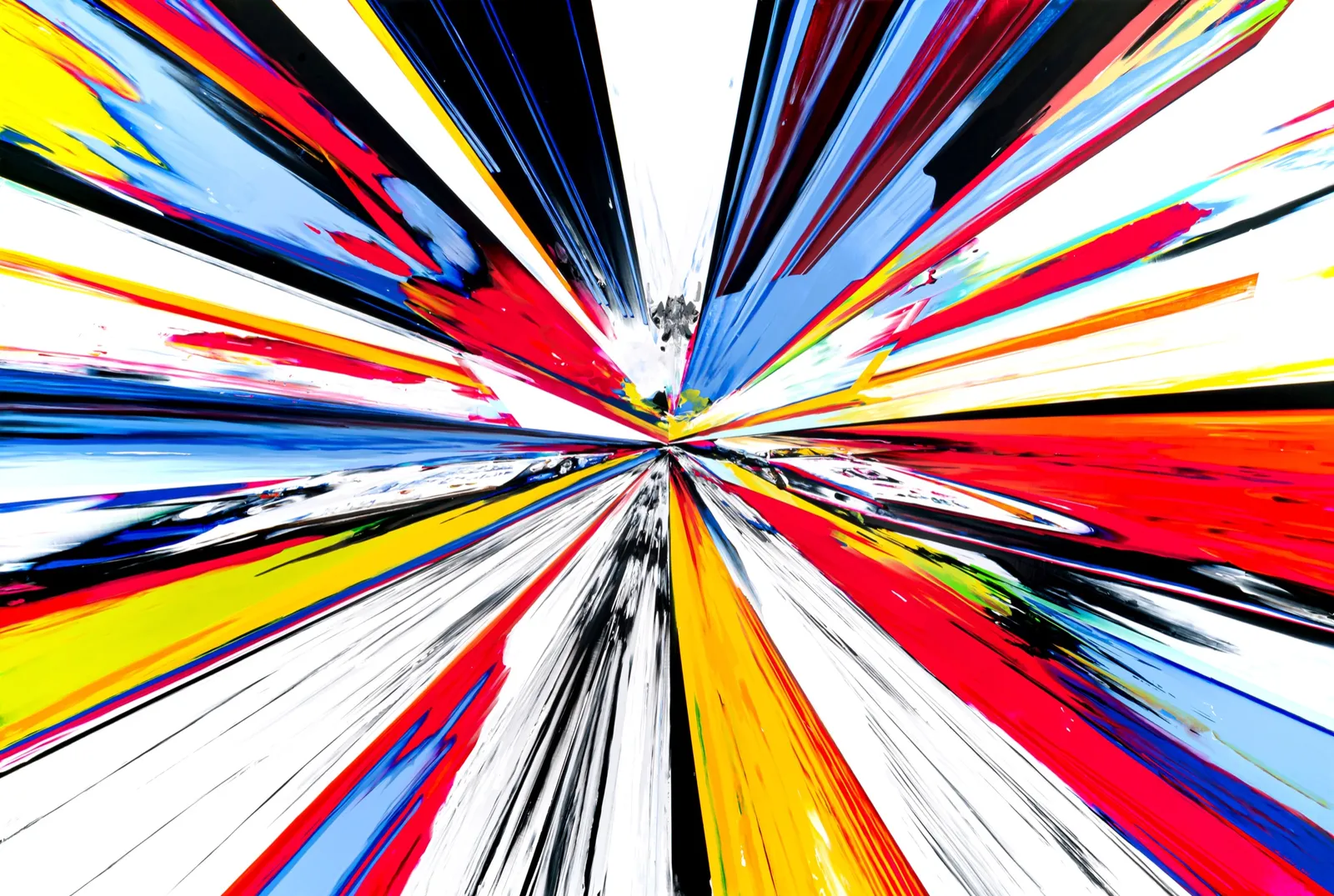
It looked like light from a distance.
On a night in Hong Kong in 2012, Minseok Kang looked at a city from the far side of the water. The paintings we read in the last note came out of that evening. He lifted a car into a roadless sky, crossed a sea, and headed for the red city up ahead.
Two years later he is inside that city.
Long Journey is a series of eleven works begun in 2014 and finished in 2015. The setting is Times Square in New York, said to be the brightest place on earth.
And yet the canvas is black.
A few red tail lights and a few scraps of yellow signage are all that remain; the buildings are smeared into darkness. From the top edge, white paint runs down in long streaks and erases the city as it goes.
The light he had seen from a distance is not here.
Arriving was not the end.
Seen from far away it was an ideal — a dazzling, towering dream of a place. Once he was inside it, he says, it was simply reality.
He calls these years a time of depression.
Through them he was digging into himself. Who am I, and where should I go. Following that question, imagination and the ideal reached their limit, and at that limit he ran into the real. He had arrived in the city, and arriving only pushed him further into the question.
That is why the series is called Long Journey. It is not a story about reaching somewhere. It is a story about having to keep going after you arrive.
Stray Racer, painted in the same years, takes place in a forest inside a dream. This one takes place in the city, while awake. The two ran side by side.
The road was there to begin with.
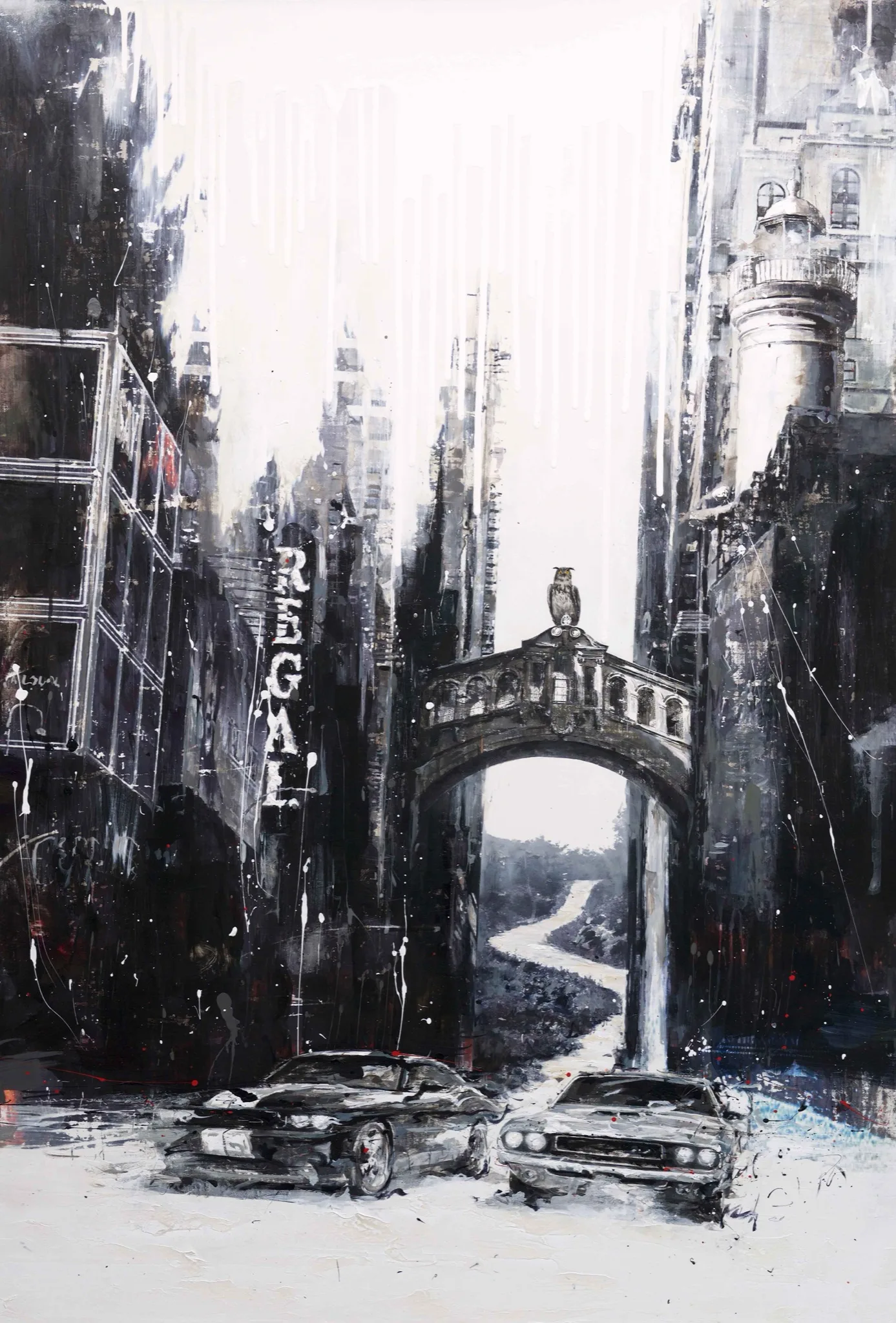
Stand in front of Long Journey NO.5 and there is a hole in the middle of the city.
The canvas is vertical. Black buildings close in on both sides, and an old stone bridge spans the gap between them. Beneath the bridge the view opens, and a white road winds out and away. Hills and trees stand on either side of it.
That is not the city. That is outside the city.
An owl is perched on the bridge. Not flying. Still. To the right stands a lighthouse — a lighthouse in the middle of a city with no sea.
At the bottom, two cars face us. They have not set off yet.
In this painting everything is in its place. There is a way out, a bird sits above it, and a light is shining.
The road drew back into fog.
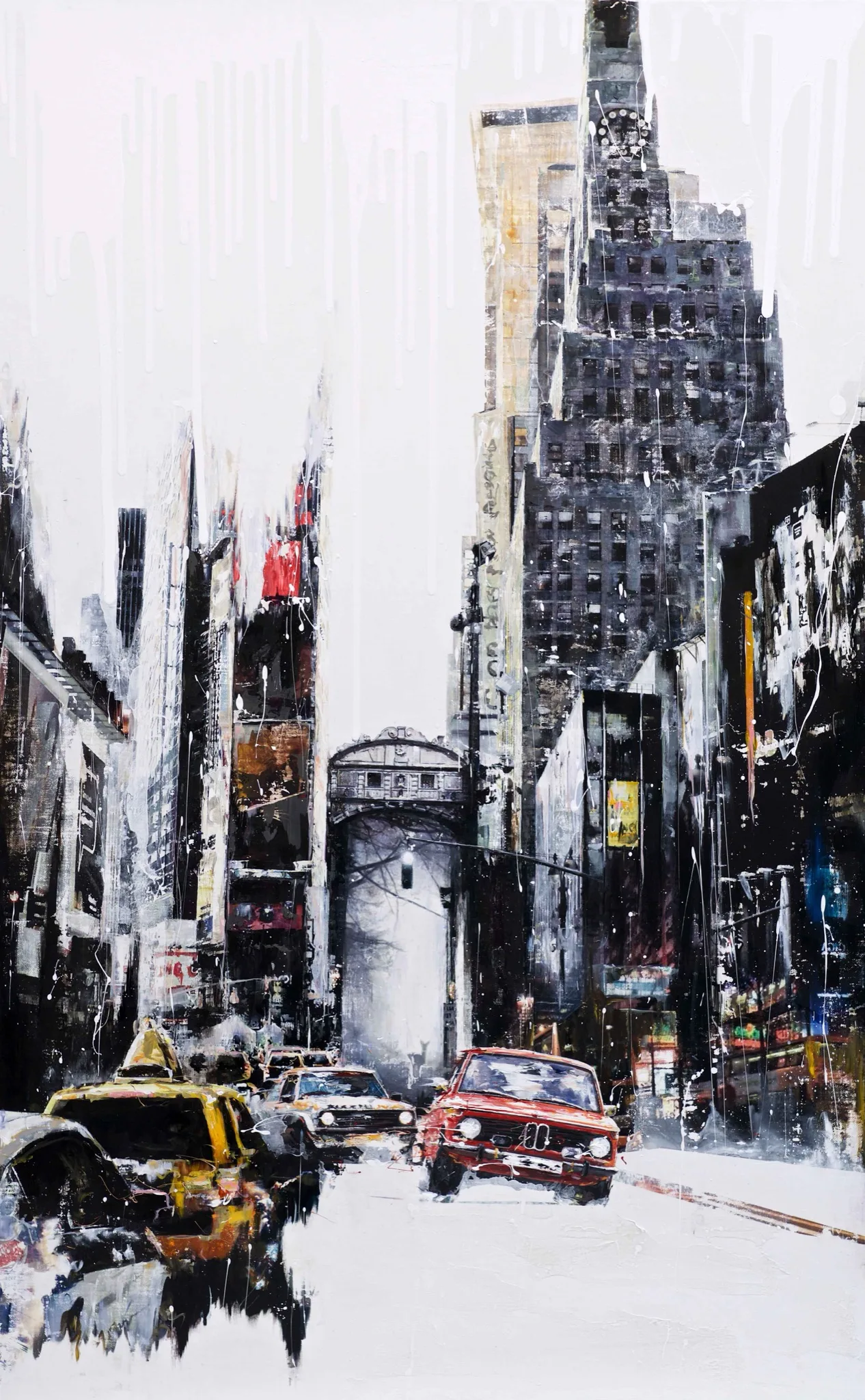
In Long Journey NO.4 the same opening has gone dim.
Same city, same bridge, but the space below it is hazy. Fog has filled it, and bare branches stand inside the fog. The winding road is no longer visible.
And in that blurred place there is a deer. Very small. In the middle of a city, just behind the cars, standing and looking back at us.
This painting still has colour. A yellow taxi and a red car come toward us, front on.
The painting does not say where that dim place is. It could be somewhere he has passed through, or a past that is already gone. Minseok Kang did not decide. That, he says, is for the viewer to decide.
So this painting is an afterglow. A canvas opened toward what is behind.
And then there is nothing.
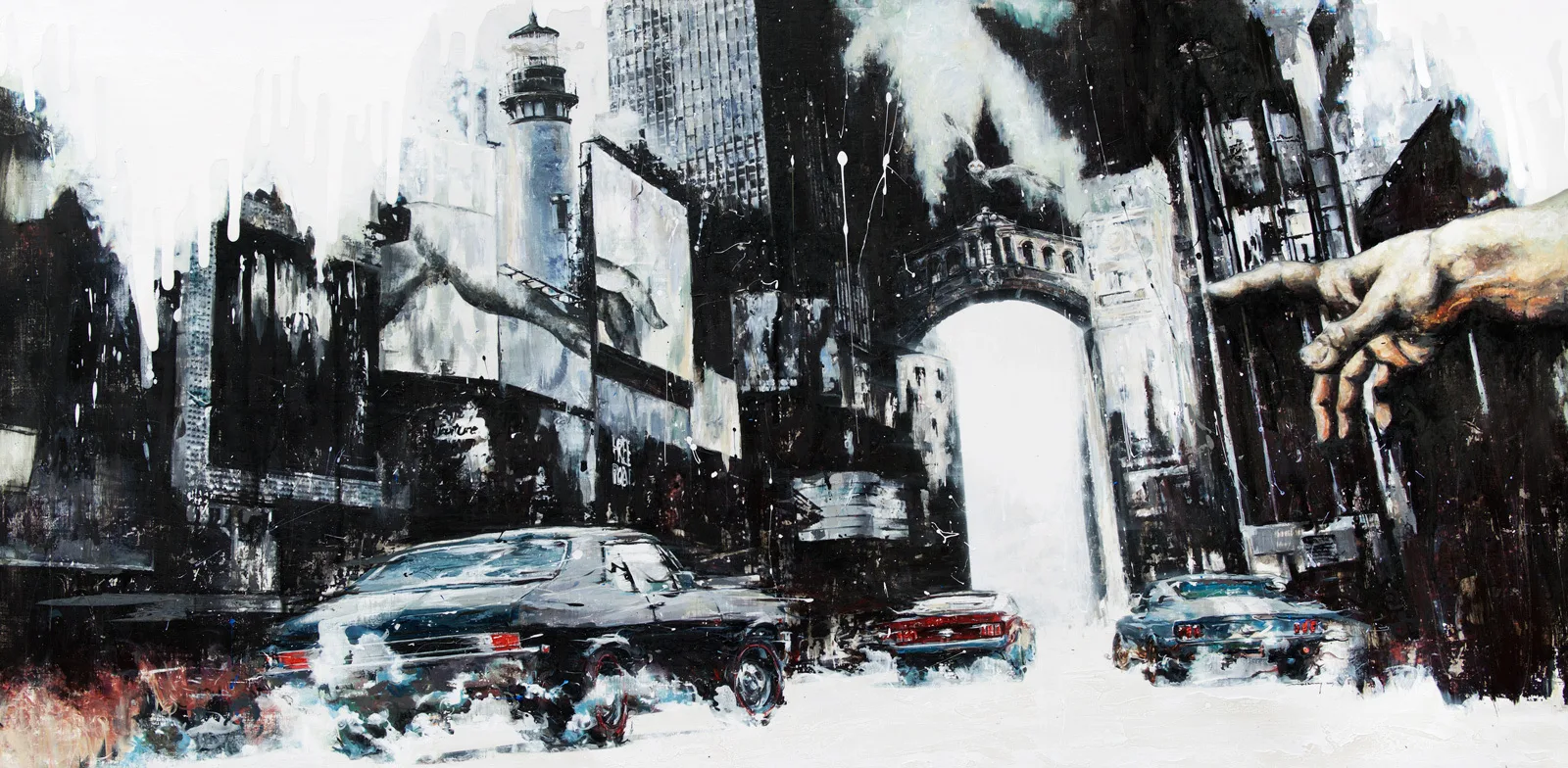
Long Journey NO.6 is the largest work in the series. One hundred and ninety-four centimetres across, ninety-seven high. A canvas that lies out sideways.
Here the cars show their backs. Three of them, side by side, driving away from us.
Ahead of them is the bridge, and beneath the bridge the view opens. But there is nothing in the opening. No fog, no forest. Only white.
The road that was clear in NO.5 drew back into fog in NO.4, and here it is gone. All of it happened beneath the same bridge.
It did not disappear. It was erased. Minseok Kang painted a new forest path here, one that led away from the city, and then covered it with white. Look closely and a very faint trace is still there.
And in this painting the owl is not perched. It is on the bridge with its wings open.
He had no choice but to cover it.
He did not look at it for a long time and change his mind. He says he could not find the answer, so he had no choice but to erase it.
That place was the future. He wanted to know where that future went. He has faith, he says, and he wants to believe in something like fate, so he went looking for the answer.
He did not find it.
He knows now that an ideal has no answer, he says, and that is what makes it painful. Life does not run the way he wants it to.
He could not paint a road when he had not found the answer. That would be putting down an answer that does not exist.
There was one more reason. If he had put a shape in there, he says, it would have blocked the viewer's own reading. Paint a road and the road becomes the answer, and the person looking only has to receive it.
He did not want that.
In 1962 Umberto Eco published a book called The Open Work. What had caught his attention around then were scores. Some composers stopped fixing the order of a piece and handed it to the performer. Which passage to play first, where to stop — the player chooses. The same score yields a different piece every time.
Eco called these open works. Not unfinished, but works whose completion is handed over.
Minseok Kang's white space became a place like that. Only the order was reversed. The composers Eco was watching decided to leave things open. Kang could not find an answer, so leaving it open was all that was left to him. Not a method — a circumstance.
A place that was painted once and then covered is not the same as a place that was empty from the start. There is a thickness there that only the person who erased it knows.
There is no road on the ground either.
There is one more thing. In this series the ground is white.
The cars are driving, and there is no road beneath them. No lane markings, no asphalt — the cars simply sit on a white ground.
It was not left blank for nothing. He says he did not want to take a road someone had already walked.
Choosing the same road, he says, does not bring you to the same place. That kind of talk is common now: this worked for so-and-so, so do it that way. He does not believe the world holds answers like that. A road laid down by someone else is not his life and not his philosophy.
So he emptied the ground. It means this is not a road. It means no one has been through here. The white tunnel says the same thing. He calls it an adventure.
In the autumn of 1945 Sartre gave a lecture in Paris. In it there is a story about a young man. Should he stay beside the mother who had been left alone, or leave home and go and fight. Either choice meant abandoning someone.
The young man came for an answer. Sartre did not give him one. He only said: you are free, choose.
Being told there is no fixed answer is not a comfort. It is a weight. No one chooses in your place, and everything that follows the choice is yours as well.
That is where Kang's empty ground sits. A road is not laid down in advance; it comes into being as you go.
One thing is different, though. Sartre did not allow for fate. Everything is my choice and everything is my responsibility, he said. Kang does not say that. He wants to believe in fate.
One of them said he would carry the empty road ahead alone. The other feels something at his back, pushing him toward it.
So many things are pointing.
NO.6 is unusually full of things that indicate a direction.
There is the lighthouse. It is light, and it means do not lose your way. From the right a large hand comes into the frame, and there is another hand on the billboard at the left. He took the two hands of the Creation, the ones that almost touch, pulled them apart, and set them pointing the same way from either side.
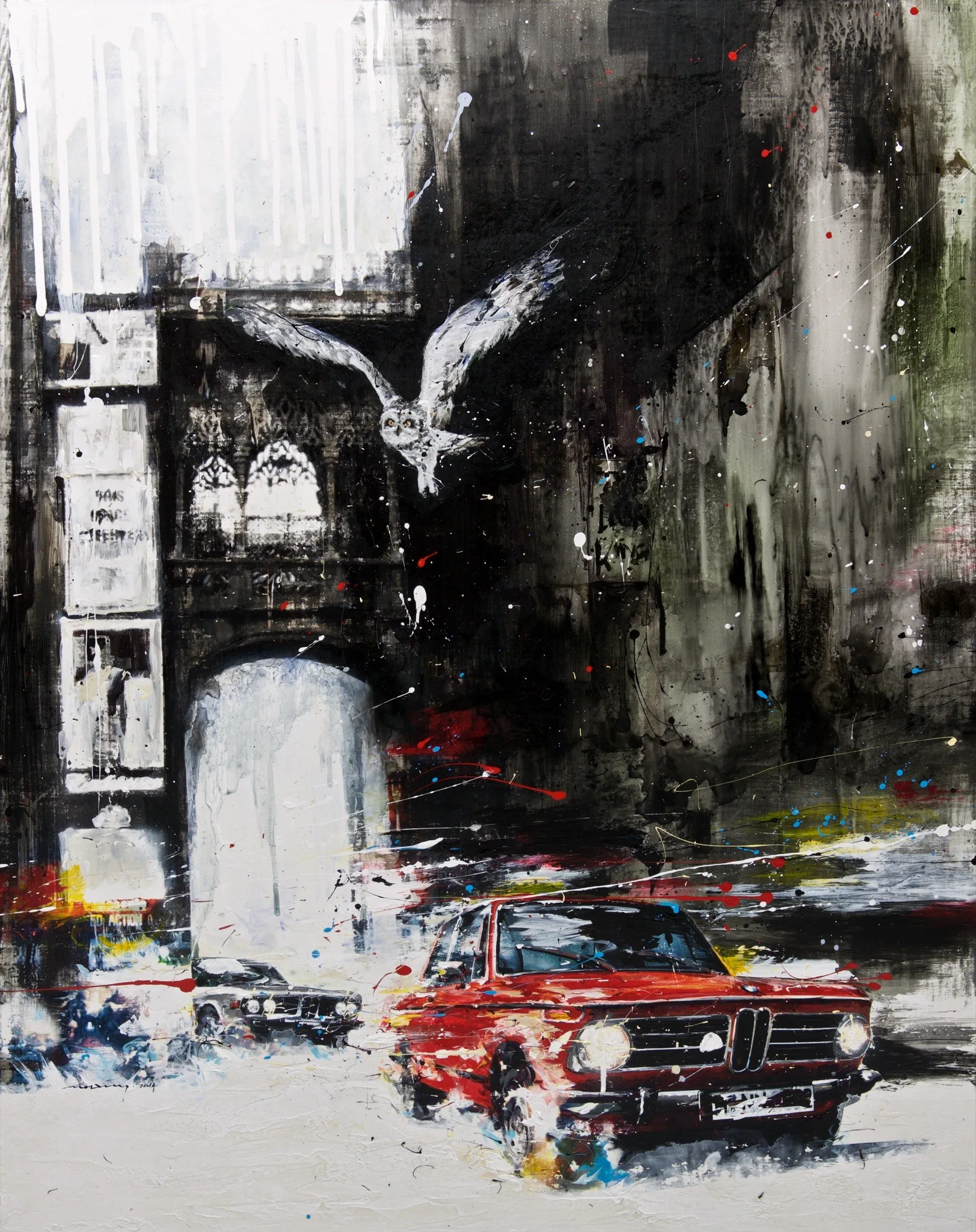
There is the owl. It is the bird that sat still on the bridge in NO.5, and in NO.2 it flies right out to the front of the canvas, yellow eyes open, looking at us. It is a bird that moves at night, and the beating of its wings means a beginning, he says.
There are three cars. Ask why three and he says it is not competition. It means he is not alone.
Two buildings and the bridge between them overlap and make a tunnel — a passage out of the city into somewhere else.
The lighthouse shines, the two hands point, the owl opens its wings, the tunnel stands open, and the three of them go together.
And the end of it is white.
There is an old saying about a finger pointing at the moon: do not look at the finger, look at the moon. The finger is not the moon. It is only a direction.
This canvas is full of pointing, and there is nothing being pointed at.
It has not been filled.
Minseok Kang has been taking his old paintings out lately. When he is working now, he says, his eye keeps going back to the older ones. That is how he came to stand in front of this painting again.
Eleven years have passed. In that time he never stopped painting. He painted a desert, he turned a canvas over, he painted two cars colliding.
So has the space he left empty in 2015 been filled by now.
No, he says. He still cannot fill it.
It has not been filled; it looks different. The place is the same and the person standing in front of it has changed. For eleven years he did not stop.
He says he does not know whether that direction is right. It may be a road he should not take. And still, he says, there is such a thing as a fate you cannot help but follow. Painting is that, for him.
The series is only eleven works. He thought about the story for so long that he could not paint many, he says. One of them is called Do Not Look Back, and another is called It's Up to You. A painting that says do not look at what is behind and a painting that says the way ahead is yours hang side by side in the same series.
The title Long Journey does not speak of arrival. It says he is still running.
The place he covered is still white. But not being filled also means not yet being decided. What changes that place, he said, is his own thinking and his own doing. So for as long as it stays empty, it stays open.
The owl on the bridge is a bird that moves at night. It opens its wings when it is dark.
And the person standing in front of it is not alone.
References
Long Journey, a series of eleven works, 2014-2015, mixed media. The title work is Long Journey NO.6 (193.9×97cm, 2015). Also shown here: NO.5 (130.3×89.4cm, 2015), NO.4 (116.5×72.5cm, 2015), NO.2 (72.5×91cm, 2014). The series also includes Do Not Look Back (91×50cm, 2014), It's Up to You NO.1 and NO.2 (2015), and Challenge NO.3 (53×100cm, 2014). The city is based on Times Square, New York. Artist's notes and an account given by the artist in August 2026.
Technique — a digitally composed image is divided into sections to fit the canvas and laser-printed onto paper. The printed toner side is laid face down on the canvas and bonded with heat, then the paper is wetted and torn away. Thinned acrylic is worked over both the stripped areas and the areas where the image remains, dried slowly, and paint is finally poured across the surface. Stray Racer, from the same years, was made the same way.
Jean-Paul Sartre, Existentialism Is a Humanism (1946) — the text of a lecture given in Paris in 1945, containing the passage in which Sartre refuses to answer the young man asking whether to stay with his mother or go and fight, and says only: you are free, choose.
Umberto Eco, The Open Work (1962) — using scores whose order is set by the performer, Eco argues that a work is not finished in the author's hands but completed by the person interpreting it.
The finger pointing at the moon — a saying long used in Zen. Do not mistake what points for what is pointed at.