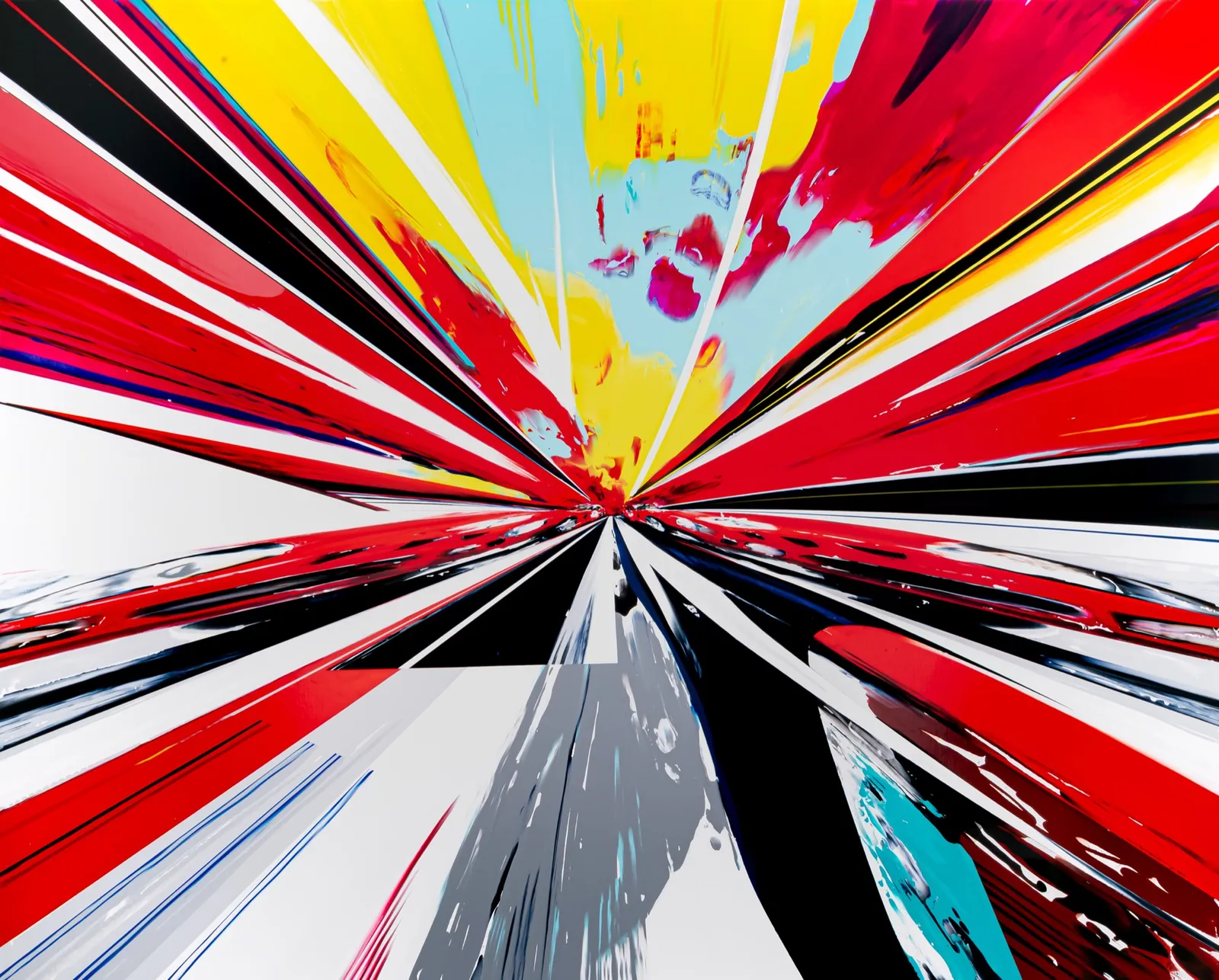
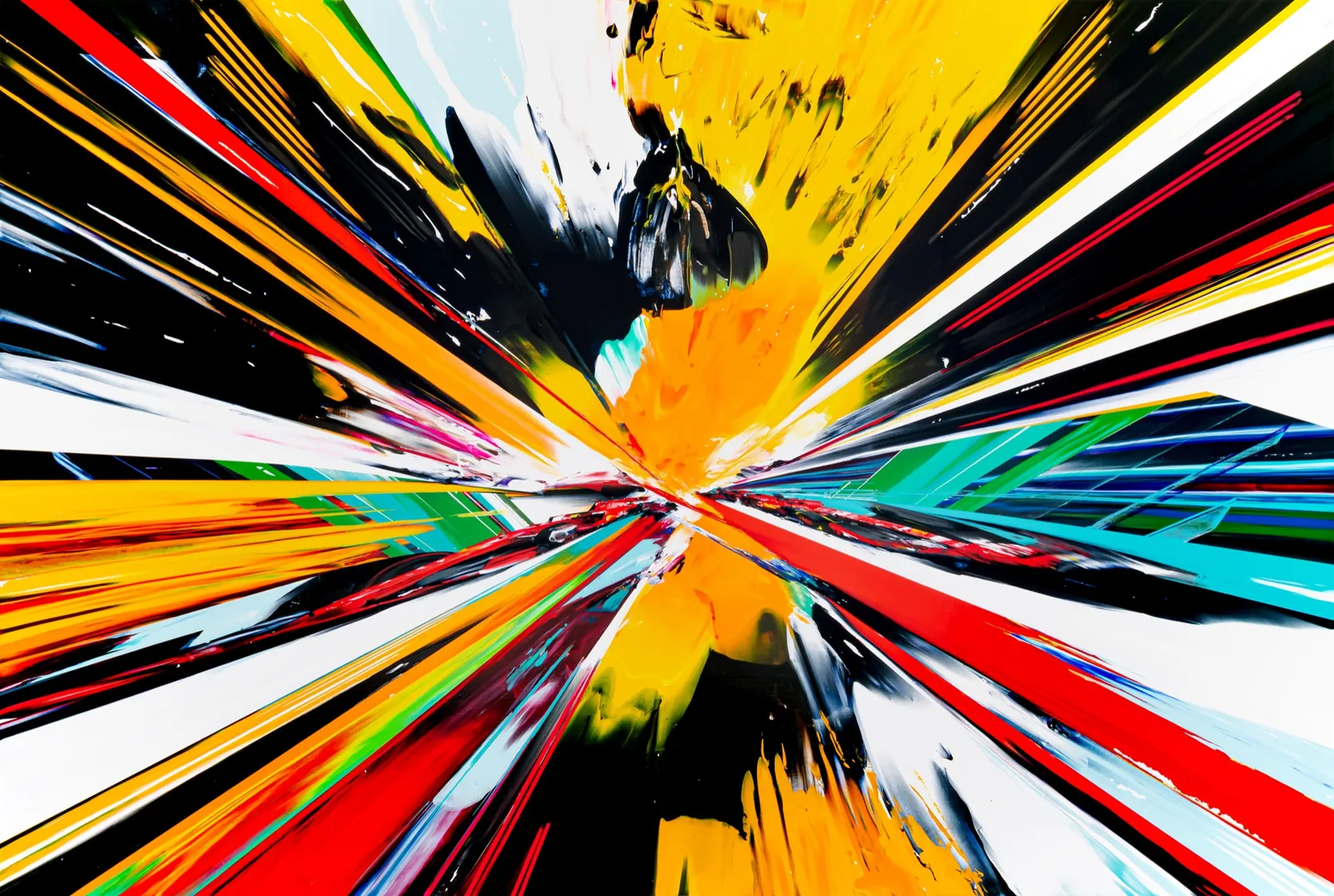
The Power to Move Against Time, Timeleap
'Timeleap' is a term science-fiction films and anime are fond of. The power to leap across time — into the past, into the future — is a familiar imagining we have met countless times in stories. It is neither a concept proven by physics nor an ability we actually hold, but a name given to a wish anyone has harbored at least once: the wish to move against the current of time.
Minseok Kang brings this popular language of the imagination into the title of his own series. The leap that was possible only inside a screen, he actually undertakes on canvas, with paint and thread. That moment Minseok Kang calls the 'tunnel-line instant.' A narrow, swift passage that crosses from the present into the past, and on again into the future. If we remember the 'Reversed Boundary' we met in the fifth note — the inner world painted on the ungessoed back of a canvas whose cloth had been turned over — then Timeleap is another door leading to that same boundary. There, what was reversed was front and back; here, what opens is the before and after of time.
A painter who has always painted the fast now paints time itself. And yet the way he handles time is a little strange. He goes to the past and he goes to the future, but wherever he goes, the place his brush finally returns to is always the 'self of now.' This note follows that strange round trip.
The Cohabitation of Two Mismatched Speeds
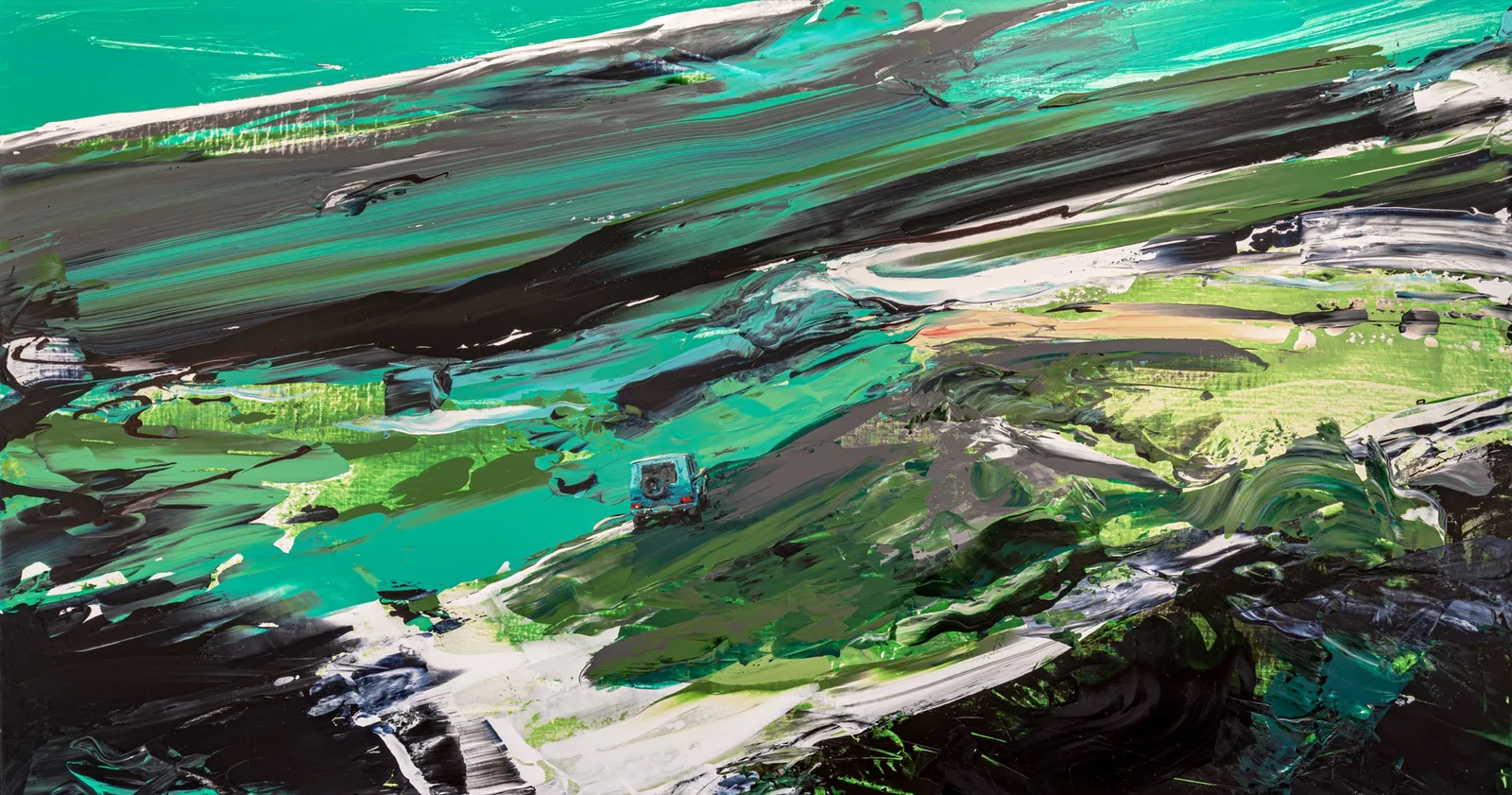
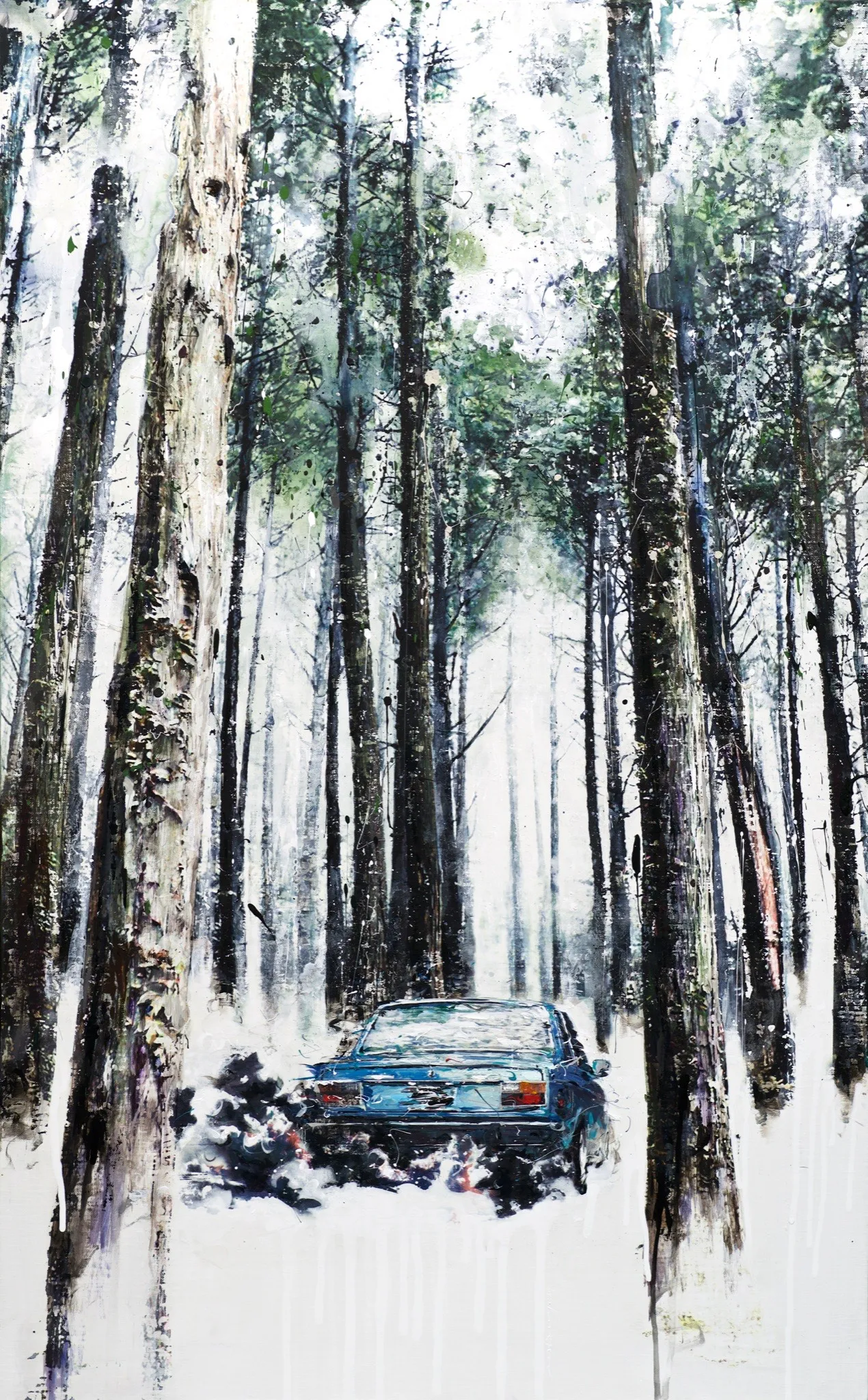
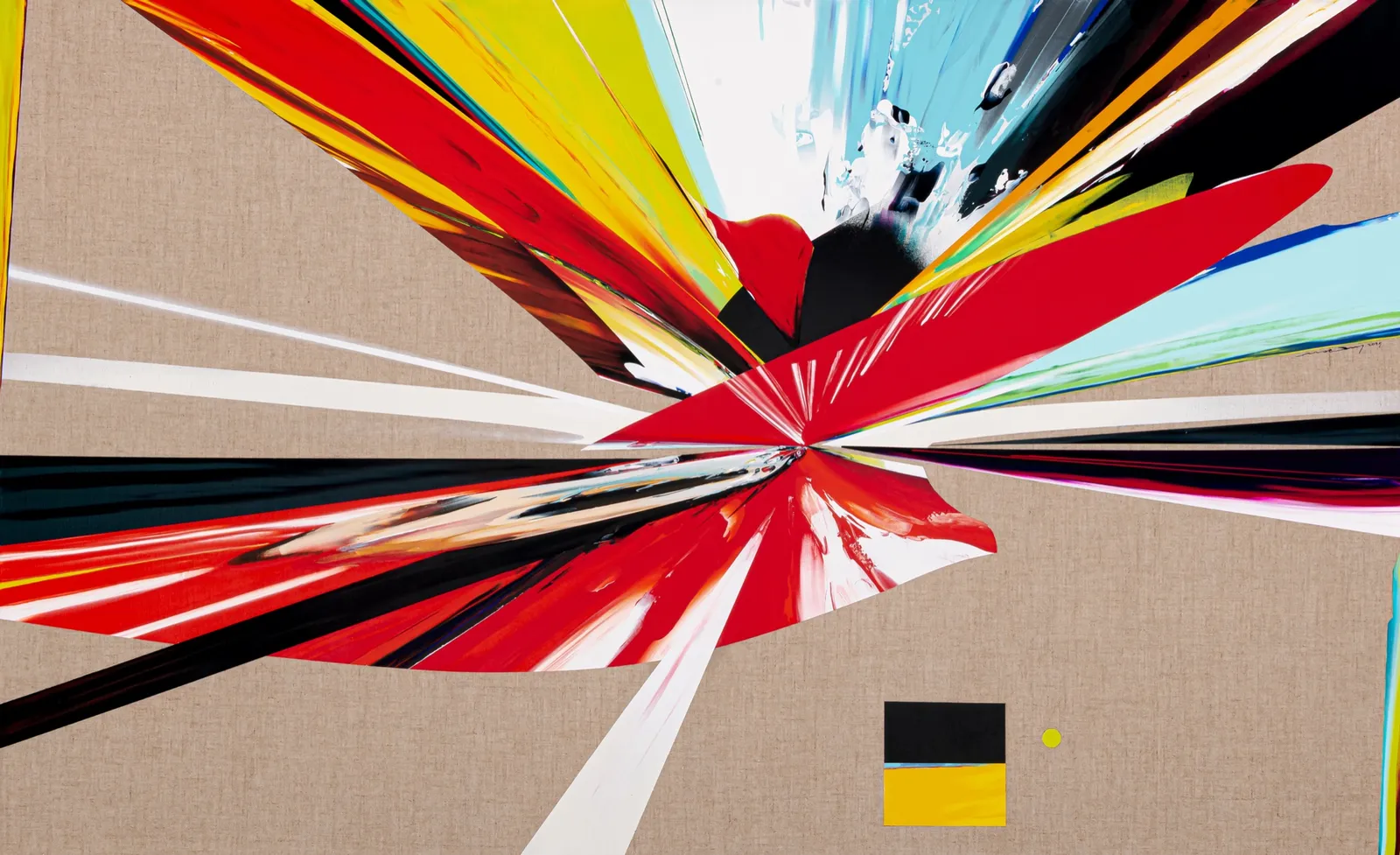
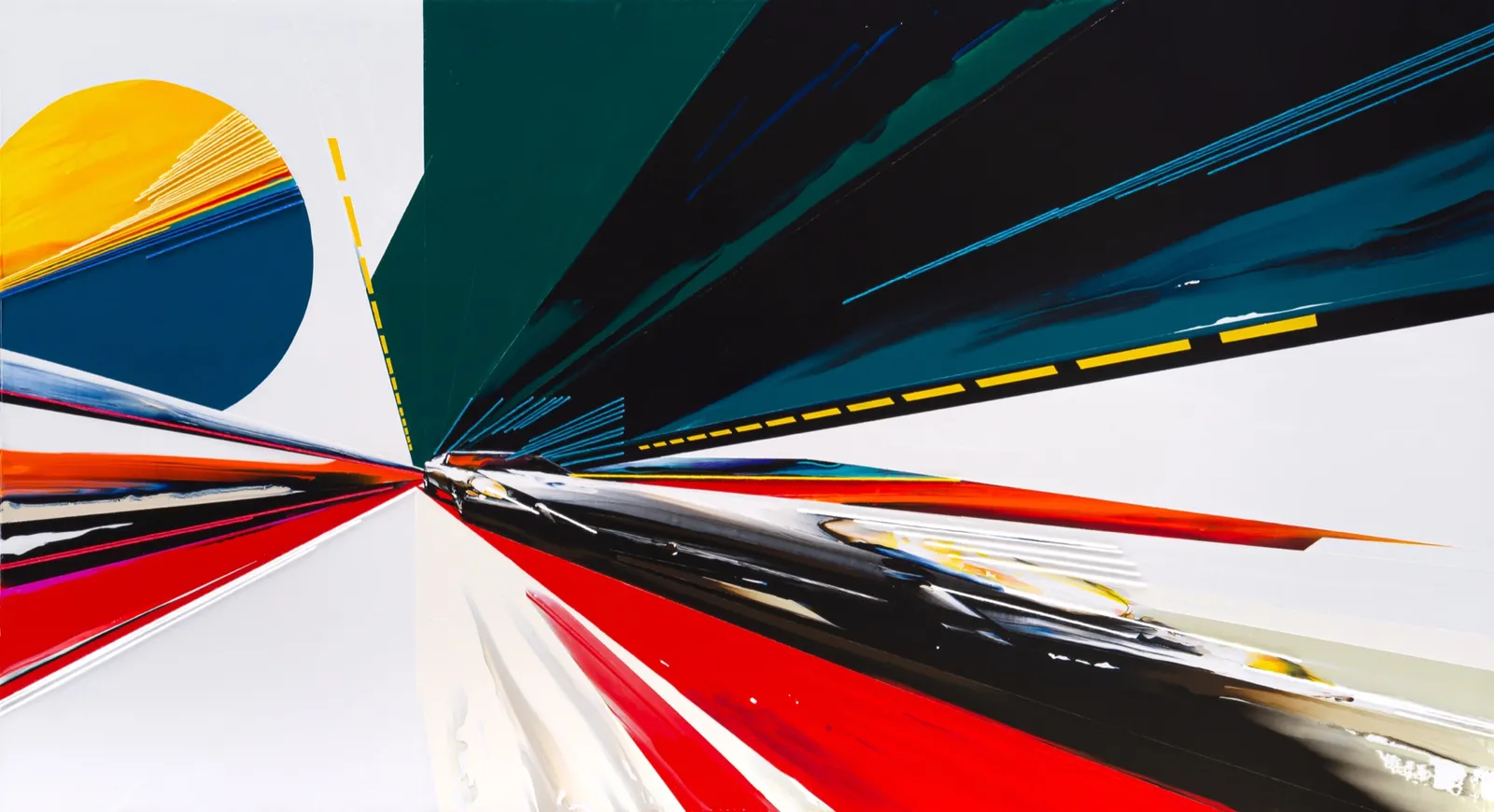
Standing before the Timeleap series, the first thing that catches the eye is a collision of speeds. The surface races, as any Minseok Kang painting does — paint flung out at two hundred kilometers an hour, forms dissolved into light. And yet upon it lies thread. Stitch by stitch, needle by needle, an embroidery laid down at a slowness of a few centimeters an hour.
Within a single surface, two speeds cohabit. The instant-quick race, and the sewing over which the hand lingers long. Minseok Kang does not bother to suture this mismatch. He sets the two side by side instead. When slow thread passes over swiftly exploded color, the painting begins to read not as one scene but as layers of different times.
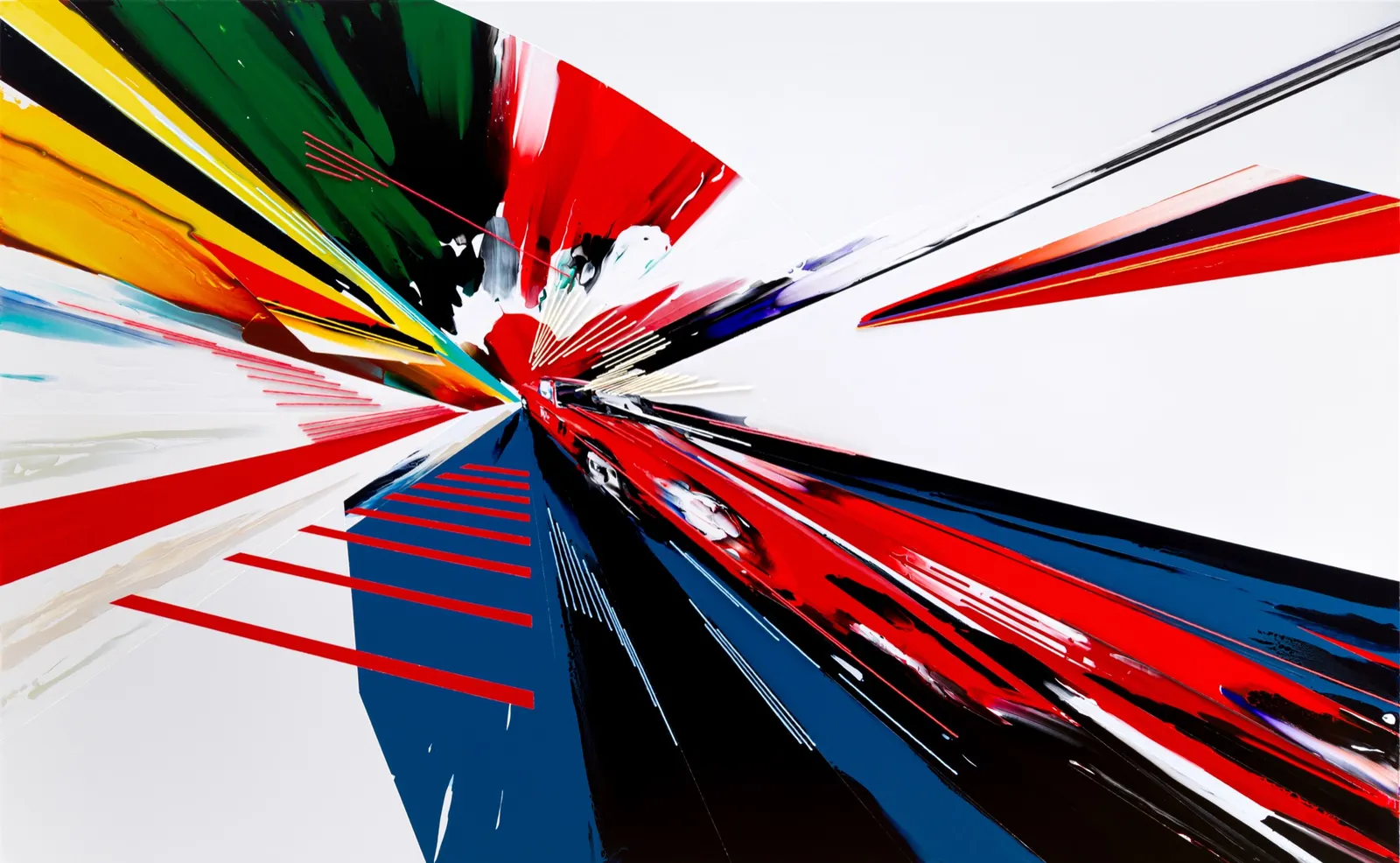
And this embroidery is the language of one particular period. Thread enters only in the 2022 works, Timeleap II through IX; from X onward, made in 2023 and after, there is no embroidery. Paintings with thread and paintings without it both exist, and a single passage joins them. The embroidery we see now is a trace of time touched by hand, set at the mouth of that passage.
Fate, in the End, Arrives There
At the heart of Timeleap lies a single sentence of Minseok Kang's. Even if he returns to the past and changes his choice, the self of the present ends up the same as now. Even if he goes to the future, the self he finds there is the self he is now. Wherever he leaps, the story returns to the 'artist's now.'
This intuition runs exactly counter to the grammar of time travel we usually know. The meteorologist Edward Lorenz's famous 'butterfly effect' — the story that a butterfly flapping its wings in Brazil can set off a tornado in Texas — says that a very small difference, passing through time, grows uncontrollably until it branches into an entirely different outcome. A time of divergence. What Minseok Kang sees is precisely the reverse. Change the past, and the result gathers back again to the single point of the 'self of the present.' A time of convergence. The two images stand side by side not as better and worse, but like mirrors reflecting each other on the same axis of time.
The writer Jorge Luis Borges, in 'The Garden of Forking Paths,' drew a world where time splits into countless branches at every moment of choice, and all those branches exist at once. Time like a fan flung wide open. Timeleap folds that fan back up. A fan whose every branch, however different, gathers in the end into a single rib. Just as the distorted car in Minseok Kang's paintings is drawn each time into the same vanishing point, his time, too, always folds and returns to one place.
Then is this convergence resignation? In Minseok Kang it is not. Here the philosopher Friedrich Nietzsche quietly steps to his side. Nietzsche asked whether one could say yes to the same life repeating itself infinitely (eternal recurrence), and told us to embrace 'now, just as it is' rather than try to change one's fate (amor fati, the love of fate). Where the classical fatalism of 'what will happen tomorrow is already fixed, so nothing you do matters' tends mostly to tilt toward resignation, Minseok Kang's convergence turns instead toward affirmation. The fact that one returns, in the end, to this place becomes not fear but reconciliation. A warm fatalism that embraces the present in the face of the temptation to undo — that is the fable Timeleap rewrites in the language of time travel.
The Force of Paint Held by Thread — Embroidery as Control
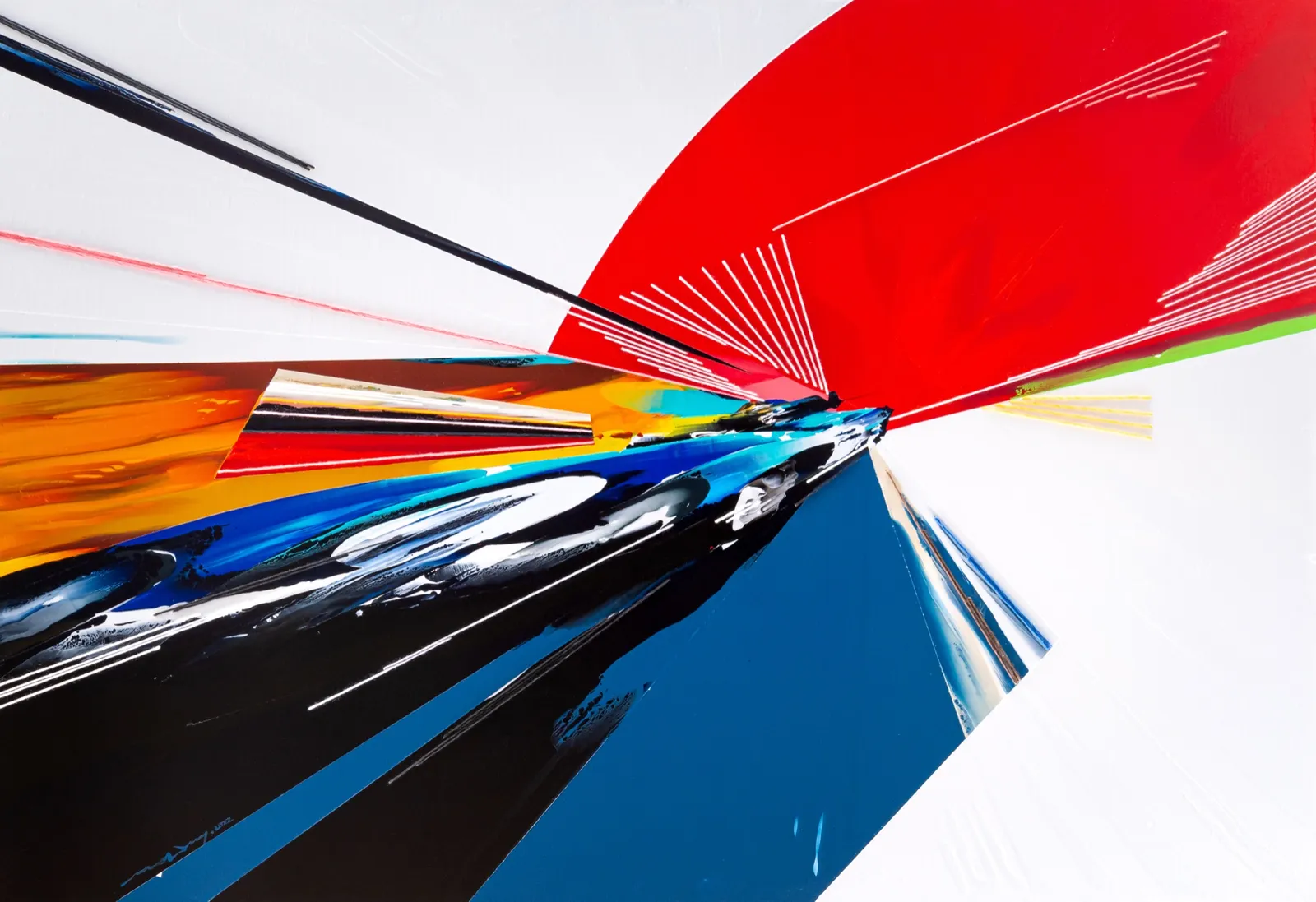
Then why thread? Minseok Kang's answer is clear. Within the painting there is pattern, and there is 'control.' The embroidery is a device that holds down, with thread, the erupted force of the paint.
And this language of control did not first appear in Timeleap. According to the artist, thread was already on his canvases earlier, in the ⟨Endless Force⟩ series. There, what the embroidery held down was not time but the 'beast' — the inner shadow and rage that began to appear in his work around 2017. Stitch by stitch, the thread subdued the erupting force of that beast. And as the story crossed over into Timeleap, the object the thread controls shifted from the beast to 'time.' The controlling hand stays the same; only what it holds has changed. It is here that the claim — that Minseok Kang's series each play on their own yet connect into one — becomes clearest: the same needle that once tamed the beast now tames time.
Thread and paint are, when you think about it, a pair that cannot mix. One flows and bleeds; the other is pulled taut to draw a line. Their natures differ, and they do not seep into each other. Yet Minseok Kang lets the two coexist on one surface without forcing them into reconciliation. Unmixed, the two are diluted into a single present afterimage. In the moment thread pins down, stitch by stitch, the force of paint about to explode, an uncontrolled speed settles at last into a single pattern.
In taking thread as a medium, a few artists come to mind alongside him, though each moves in a different direction. Louise Bourgeois tore and re-sewed private cloth — clothing, bedding — making sewing a language of the mind. For her the needle was a tool for mending wounds, used, as she put it, 'to repair damage.' If Bourgeois heals wounds with thread, Minseok Kang holds time with thread and controls the force of paint. His needle lies on the side of mastery rather than of recovery.
The weaver Anni Albers thought through the structure and discipline of thread within the strict constraint of the loom's grid, and Alighiero Boetti used embroidery as a vessel for order, disorder, and time. Only, where Boetti handed the choice of color to artisans and thus 'dispersed' control, Minseok Kang's thread 'concentrates' control into his own single hand. A decisive difference splits beneath a similar surface — Minseok Kang's embroidery is not a narrative of healing, but the discipline of a hand that inscribes time and holds force.
The Self at the Center of Everything
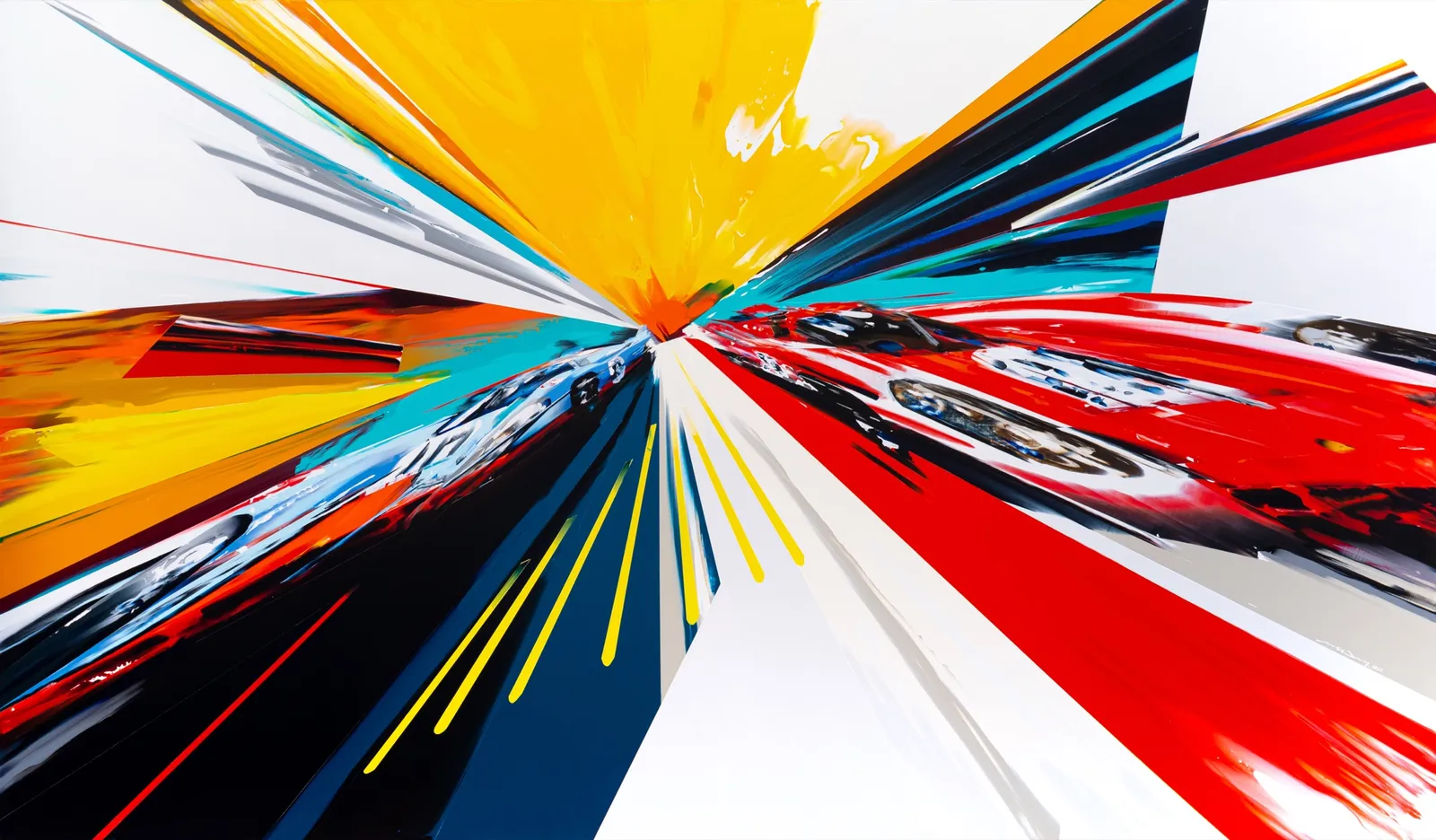
The cars of Timeleap are distorted along the lines of perspective. Though the handling resembles that of his other series, Minseok Kang places this work at the 'center' of his own story. The geometrically warped car is, for him, a portrait of 'modern people confined within time.' A machine built to race is held fast within the frame, unable to go fully forward or back, caught in a single layer of time.
This sense of arrest is confirmed in the exhibition space as well. At 《A DREAM CAR: The Dream Race》 at Corner Gallery in Seoul in 2025, Timeleap hung alongside Paint Desert — paintings that speak of racing met their viewers precisely where the racing had stopped. To paint the running thing, yet to hold that running still and show it: that is how Minseok Kang handles time.
And here everything gathers to a single point. Minseok Kang says that every environment is diluted and altered around the 'self.' Whether he goes to the past or the future, whether thread is there or not, however the car is distorted — at the vanishing point of the story the artist himself is always set. The series may each play on their own, but every story connects in the end, and at the very seam of that joining stands the 'self.'
The next note steps once more out from this center. The thread and speed, the reversed boundary and converging time we have followed until now have all pointed toward a single direction. Reading MINSEOK keeps folding inward toward that one point — the artist himself. To be continued in the next note.
References
Friedrich Nietzsche, 『The Gay Science (Die fröhliche Wissenschaft)』 (1882) — 'eternal recurrence (die ewige Wiederkunft des Gleichen)' first appears in aphorism 341, and 'amor fati (the love of fate)' at the opening of Book IV (aphorism 276). 『Thus Spoke Zarathustra (Also sprach Zarathustra)』 (1883–1885). Edward N. Lorenz, 'Deterministic Nonperiodic Flow' (Journal of the Atmospheric Sciences, 1963) and the 'butterfly effect' lecture (AAAS, 1972) — sensitive dependence on initial conditions (chaos theory). Jorge Luis Borges, 'The Garden of Forking Paths (El jardín de senderos que se bifurcan)' (1941), reprinted in 『Ficciones』 (1944). Aristotle, 『On Interpretation (De Interpretatione)』, ch. 9, the 'sea-battle tomorrow' argument — the classic of logical fatalism. On the distinction between fatalism and determinism, see the Stanford Encyclopedia of Philosophy entry 'Fatalism.' Louise Bourgeois — «Louise Bourgeois: The Woven Child», Hayward Gallery, London, 9 Feb – 15 May 2022. Quotation and sources: Hauser & Wirth (hauserwirth.com), MoMA 'Fabric Works' (lb.moma.org), Southbank Centre, Crafts Council. Anni Albers, 『On Weaving』 (1965) — The Textile Atlas, Galvin Brothers 'Thread as Thinking.' Alighiero Boetti, the embroidery series «Arazzi» · «Ordine e Disordine» — Fowler Museum UCLA, Ben Brown Fine Arts.
Copyright notice: Nietzsche, Lorenz, Borges, and Aristotle are referenced to set their thought beside the artist's, and Louise Bourgeois, Anni Albers, and Alighiero Boetti are mentioned only for the sake of 'placing beside' (shared traits and a decisive difference), as contemporary and modern artists who share a similar medium (thread, cloth). No lineage or relation of influence is claimed; no plates by outside artists whose copyright subsists are reproduced, and only minimal textual quotation is used. The Bourgeois quotation is cross-checked against several sources (Hauser & Wirth, Crafts Council, and others). All plates reproduced are works by Minseok Kang.