Before a Painting from 13 Years Ago.
This time we go to an older painting.
2012 and 2013 — thirteen years ago from now. In the years since, MINSEOK has changed direction more than once. The desert we read about, the forest where he lost his way, the storm that broke into his own quiet place: all of it came after these paintings.
So ⟨Navigate without Compass⟩ stands close to where his story began. Fourteen works, two years, mixed media.
And yet something strange happens here. Almost everything his paintings say today is already in these.
The City Across the Water.
In 2012, MINSEOK went to Hong Kong.
Across a wide river stood a city. Bright lights, buildings — he says it was beautiful. And that standing in front of it made him think harder about his own future.
When people see something beautiful, they usually feel two things at once. Wonder, and the question of where they themselves stand. What shone across the water that night was a city, but what he saw was the time laid out in front of him.
⟨Navigate without Compass⟩ came out of that night. It is the title work of this series.
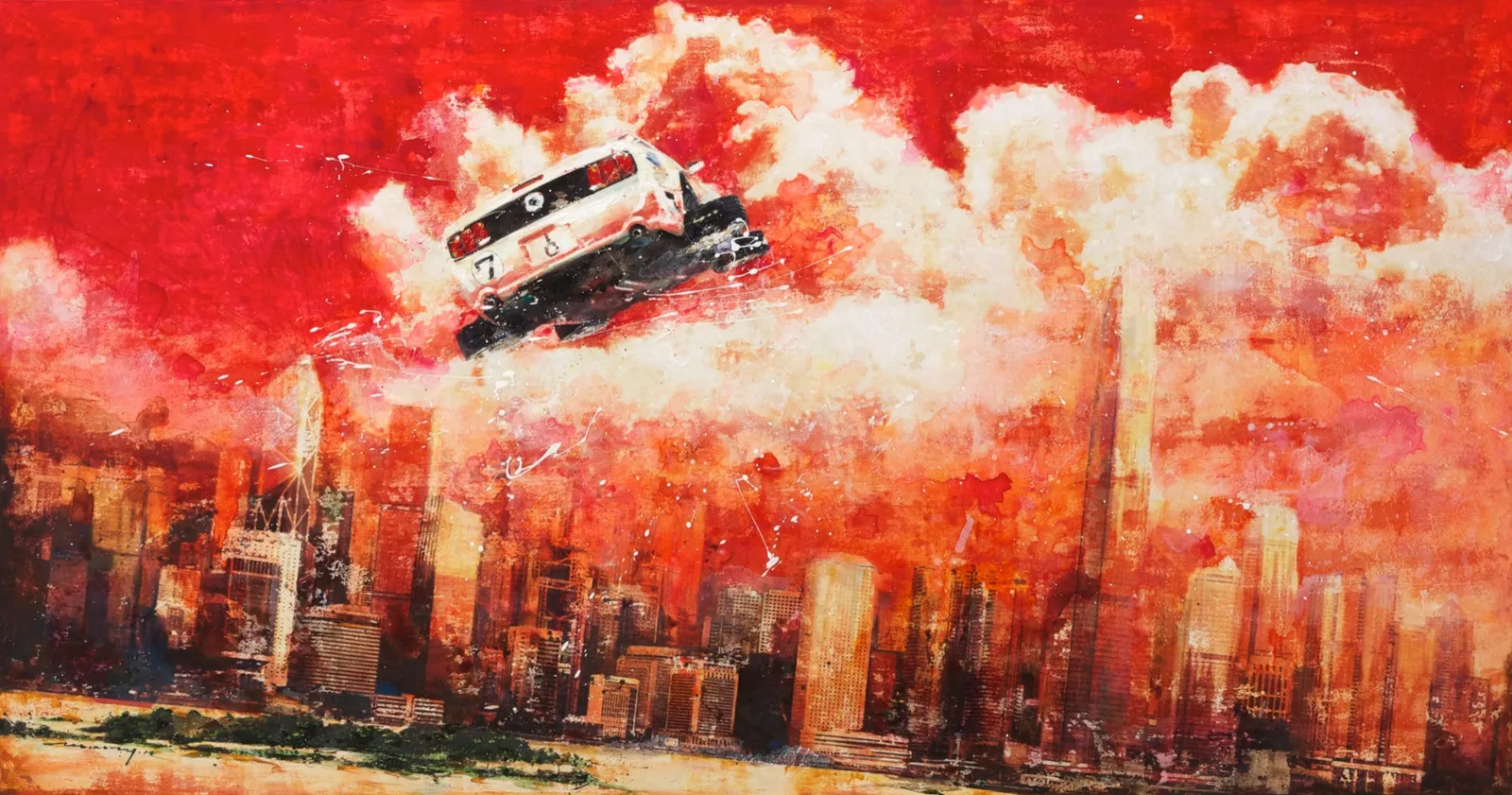
The upper half of the canvas is all red. Cream-coloured clouds billow across a red sky, and a white car floats among them. The number 7 is painted on its door. Its wheels have left the ground. Below, a city dense with tall buildings is steeped in red and gold light, and at the left edge a Ferris wheel shows through, very faintly. You can almost miss it.
Going Where There Is No Road.
The voyage in the title is not the kind a ship makes.
MINSEOK explains it this way: a sky with no rules, no road anyone has taken, and no information at all about which way to go. Crossing that sky to reach the wide city over there, the place he dreams of. That is what he means by a voyage.
Why the sky? The answer is in a film he saw as a child: ⟨Back to the Future⟩.
Many people remember the last scene of the first film. The car drives down a road, then suddenly lifts off, and just before it does, there is a line: "Roads? Where we're going, we don't need roads."
We don't need roads. That is what the boy saw in that scene, and some thirty years later he wrote the same sentence again in his own painting. A car that goes without a road, a voyage made without a compass. It is the same story.
That Light May Be a Mirage.
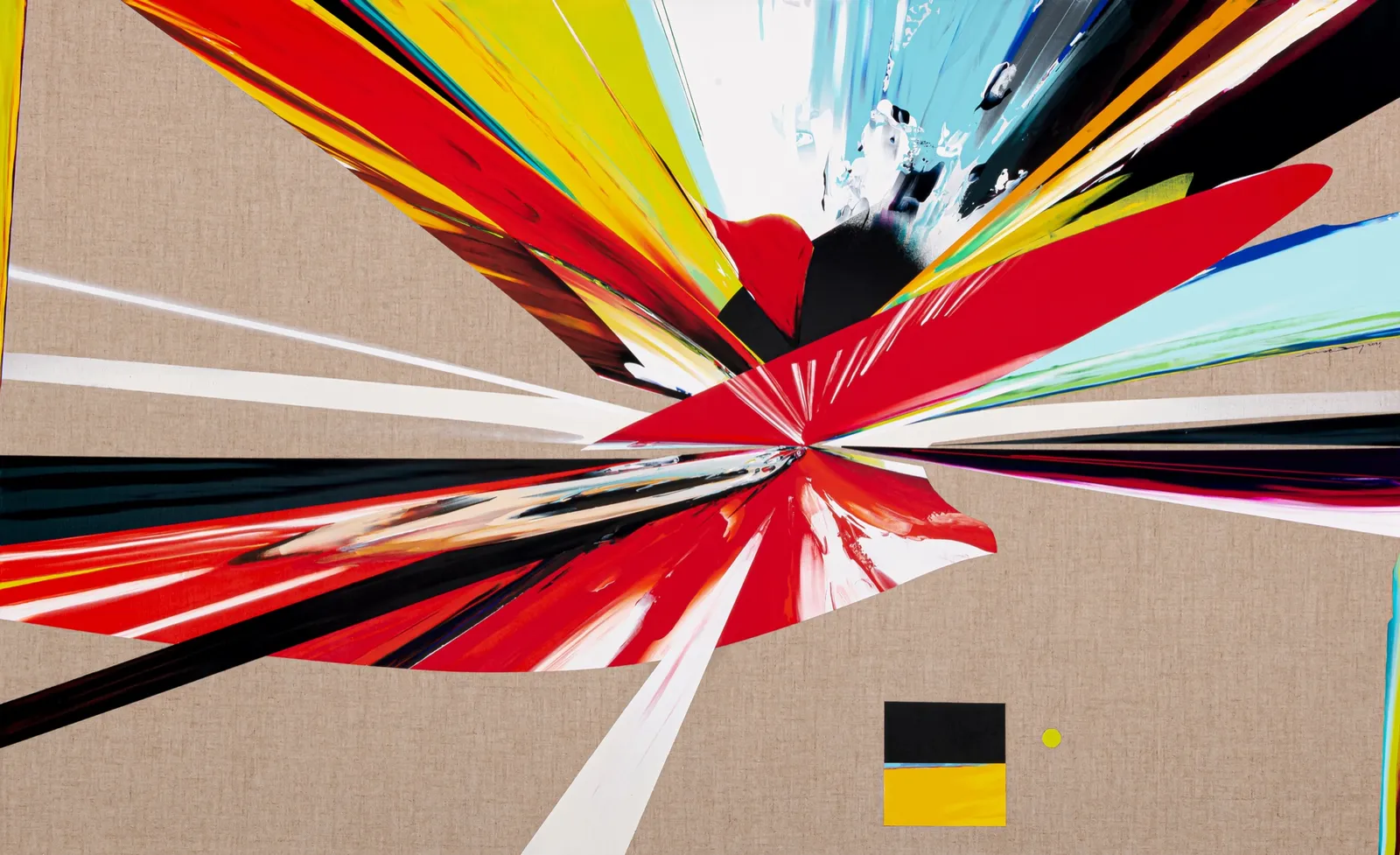
⟨Navigate without Compass NO.2⟩ leaves a different feeling.
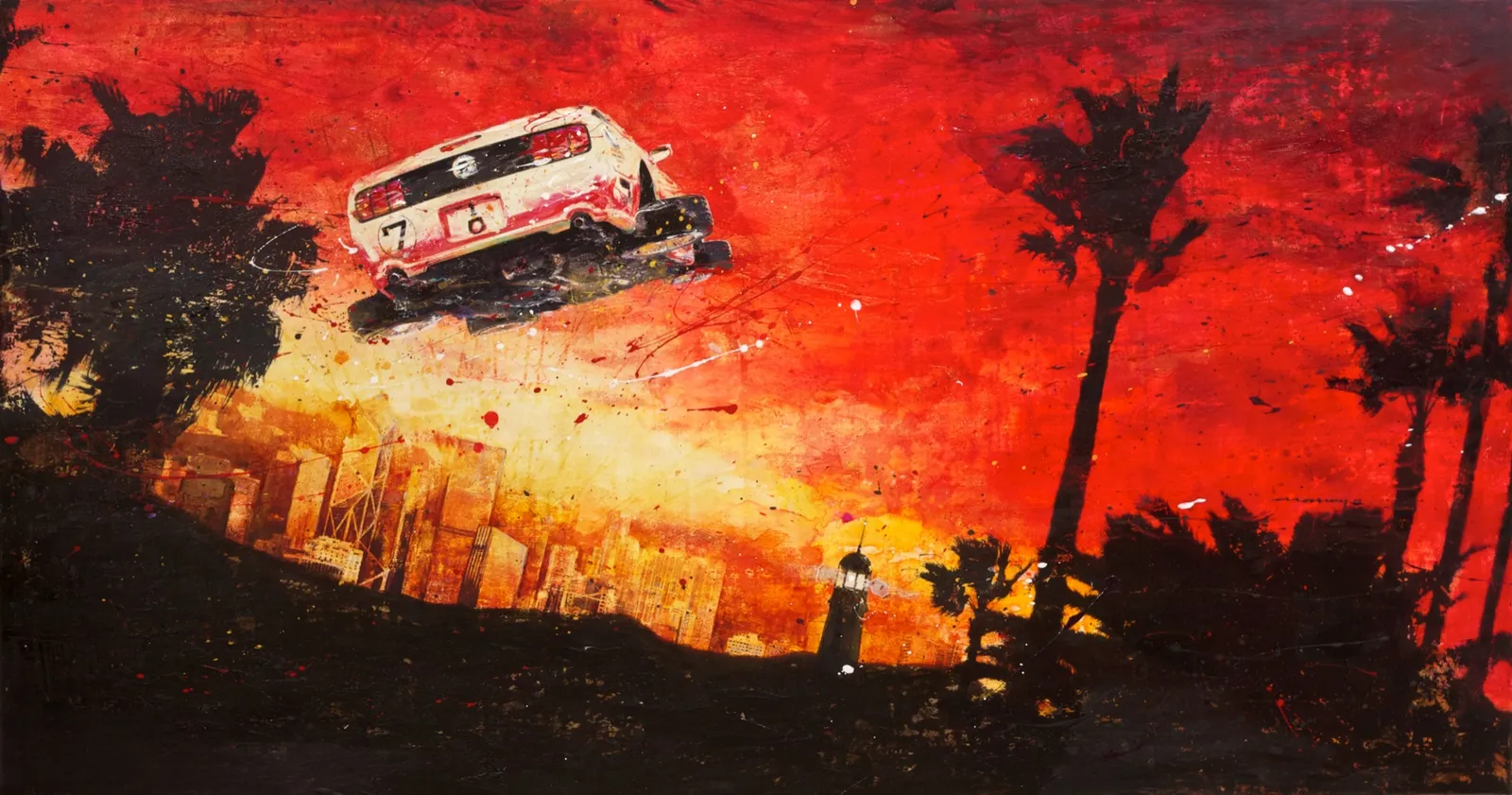
The sky is redder. Palm trees stand as black shadows at both edges, and below, a city burns gold. Between them is a tower that looks like a lighthouse. And the same car, number 7, is still up in the air.
It is beautiful, and somehow not quite real.
MINSEOK says so himself. The red sky and the city ahead may be a mirage, he says, may be an illusion. And then he adds something: perhaps going after something you cannot hold in your hand is, in the end, going after yourself.
There is a light like that in a novel a hundred years old. In The Great Gatsby, Gatsby stands at night looking at a green light burning at the end of a dock on the far side of the water. Over there, out of reach, everything he wants gathered in one place. The novel ends by saying that we go on, boats against the current, borne back ceaselessly into the past.
Only the endings differ. Gatsby was carried backward. MINSEOK's car lifts upward. Two people look at the same light; one sinks, one rises. That is why this series stands on the side of hope rather than fear.
There is a reason the surface looks like a mirage. He collaged toner ink onto the canvas, laid thin acrylic paint over it, and then left it to dry naturally over a long time. He gave the colours time to bleed, soak and settle. It is not the sharpness a hand makes. It is the blur that time makes.
Lines Across the Sky.
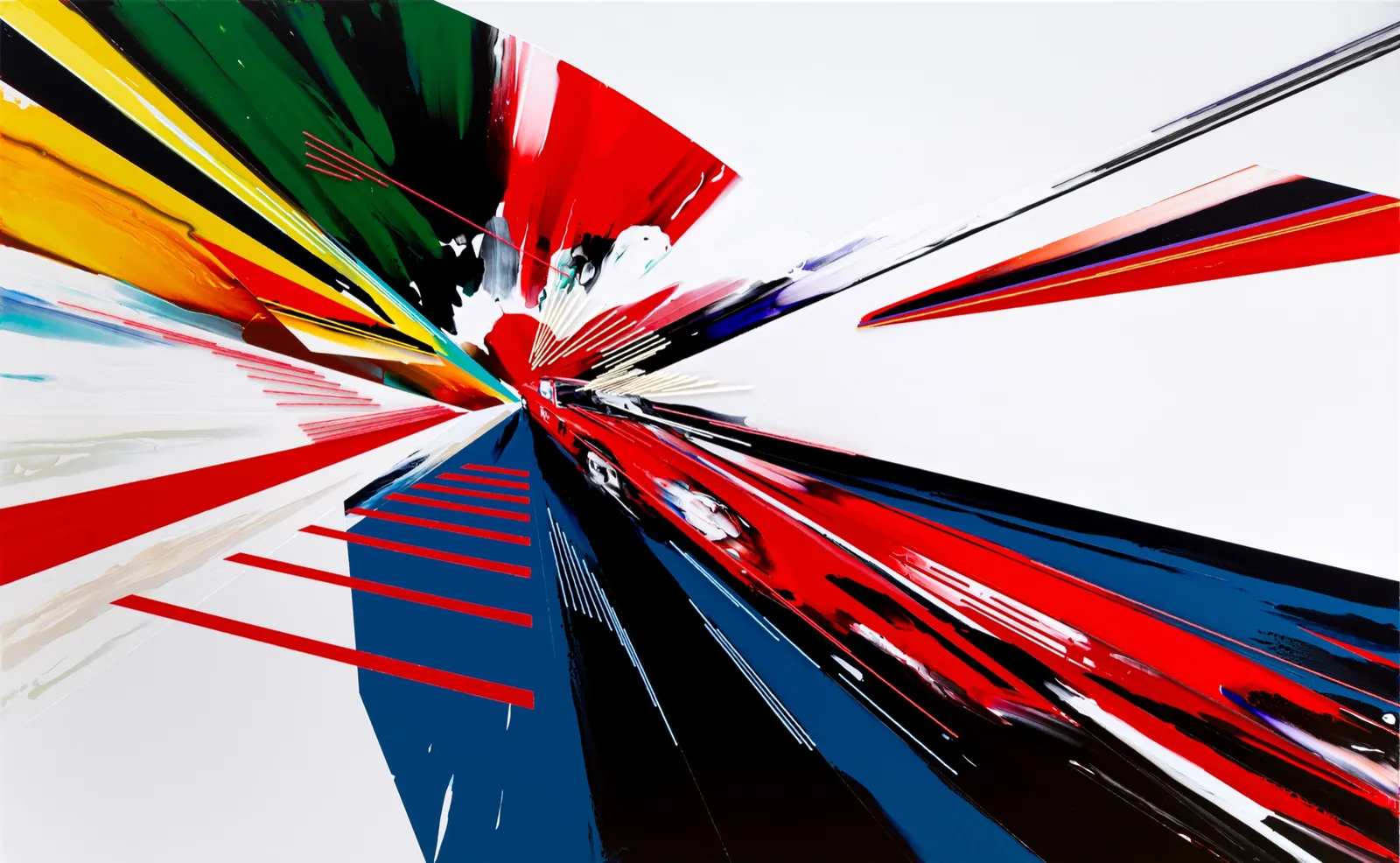
⟨Navigate without Compass NO.3⟩ is a tall canvas.
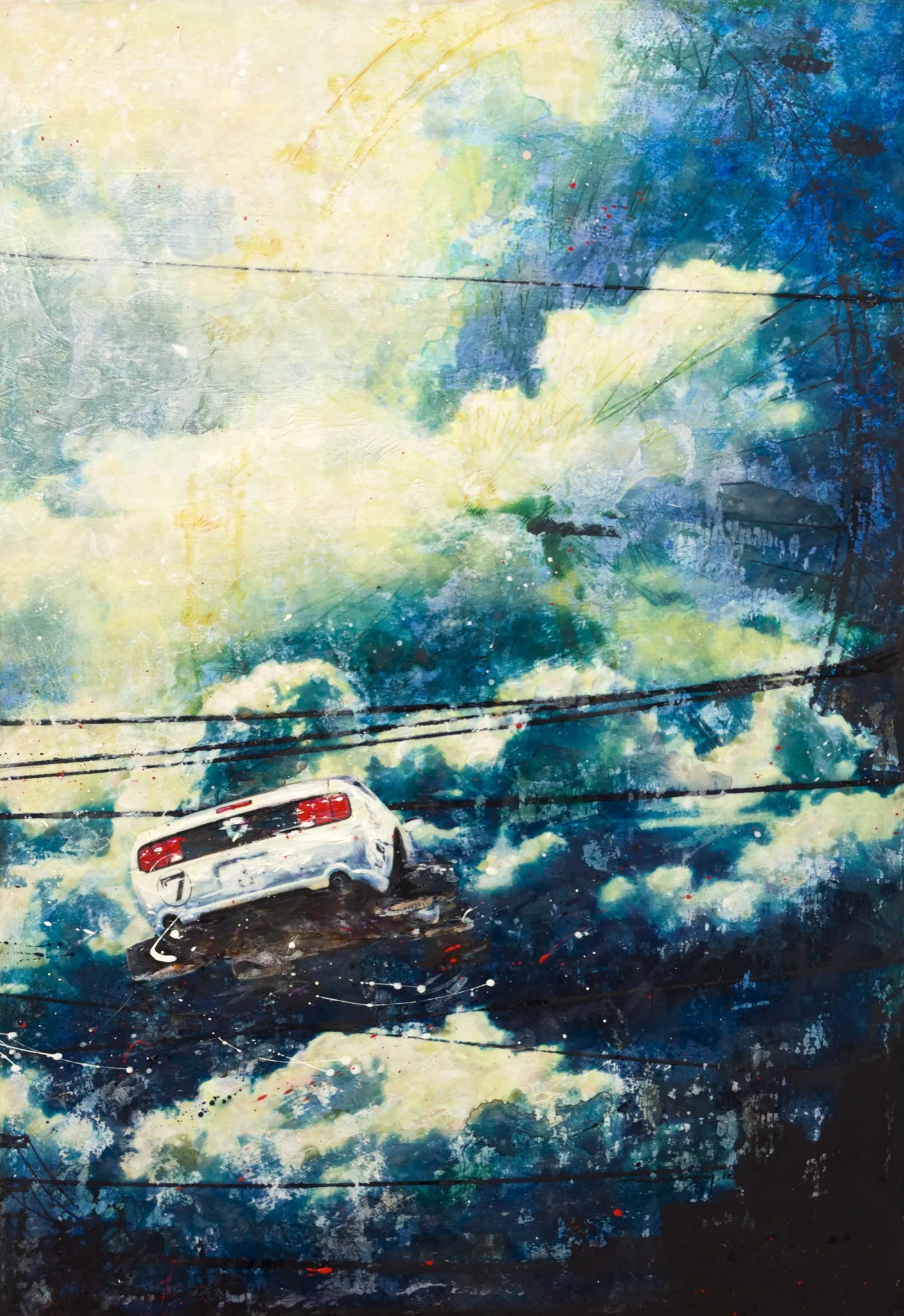
This sky is blue. Pale yellow at the top, sinking into deep blue further down, with cream clouds spread across it. The same car, number 7, passes through at an angle.
But something crosses the picture. Power lines. Several black lines run horizontally across the sky.
A power line is not a line that blocks. It is a line that connects. Poles and wires tie two distant places together with a single thread and carry news from here to there.
MINSEOK says these lines carry a strong sense of time. They join one space to another, but when they cut boldly across the picture, they become lines that join one time to another.
Come to think of it, the film we just spoke of was about the same thing. When the car lifts off, it crosses into another time. The car in this painting is also passing at an angle through those lines. Where it is going, the picture does not say. Only that beyond the lines it will be a different time from now.
Shouting from the Sea.
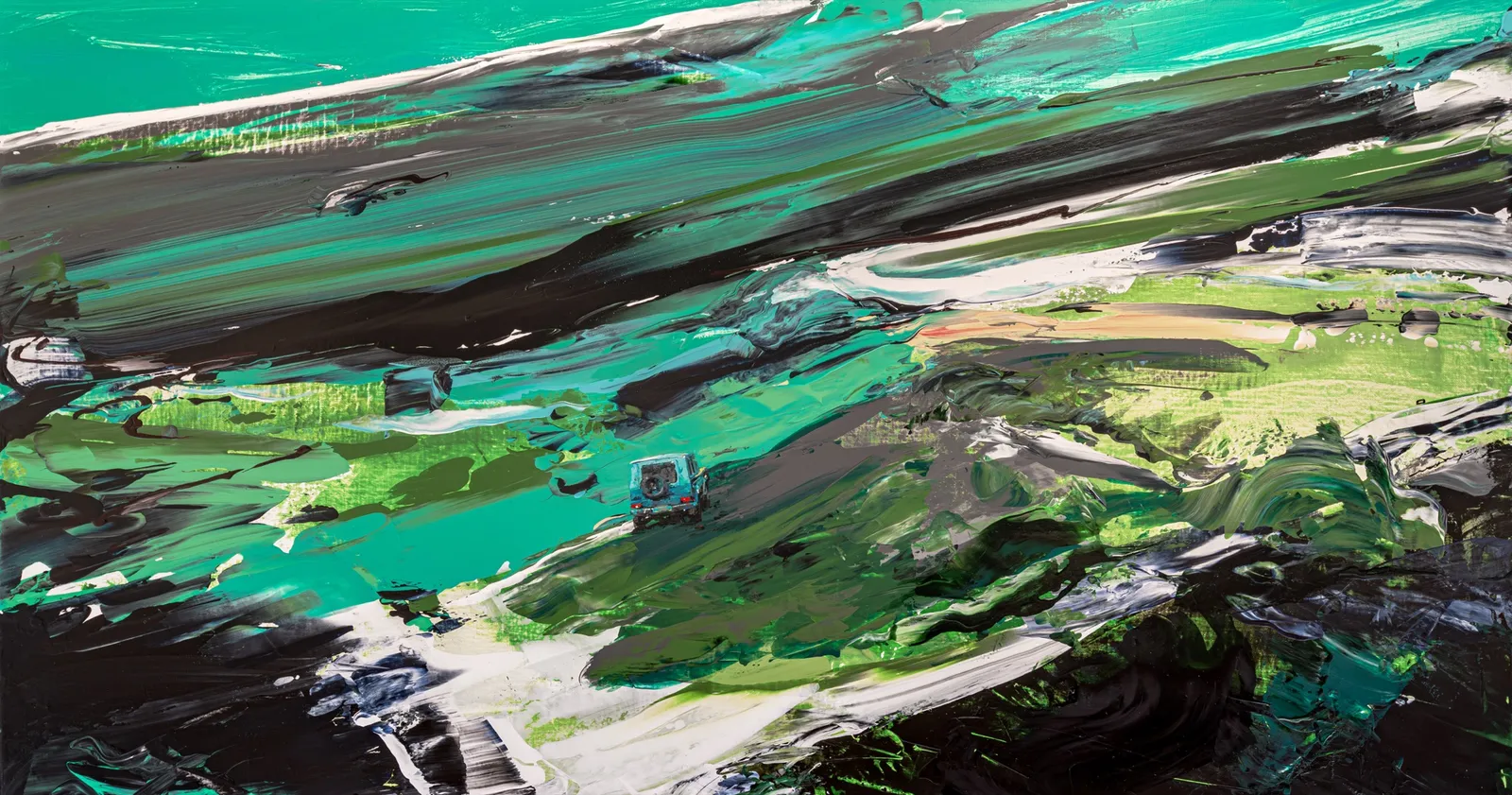
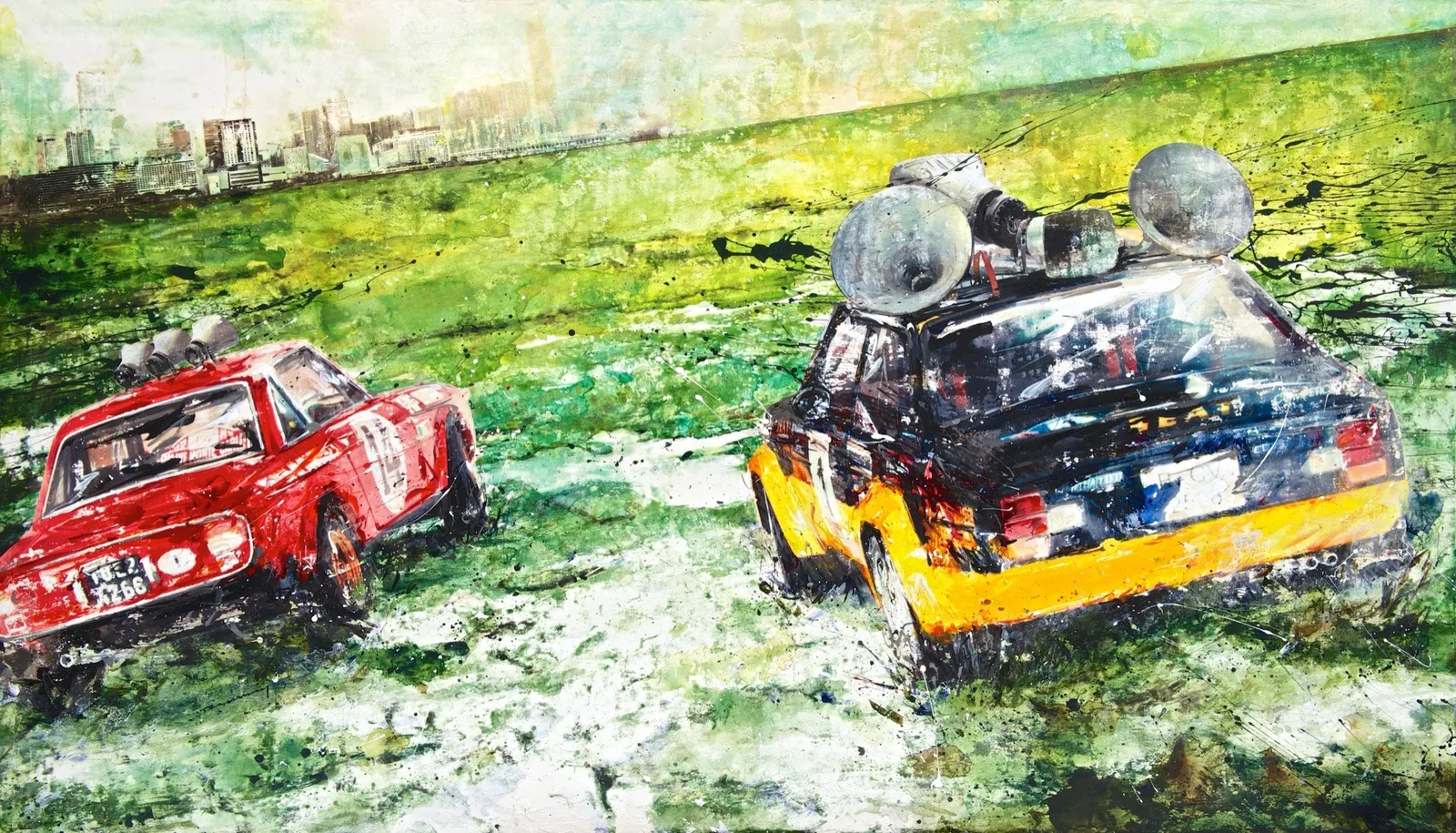
⟨Shout Destination⟩ looks like a different kind of painting. Here the car does not fly.
There is no red sky. The whole canvas is green. Two cars run side by side, and white water sprays up from below. At the very top of the picture, the outline of a city shows faintly.
But that green is not a field. It is the sea.
The cars are running on water. Something that is not a boat is crossing the sea. Just as the sky has no road, the sea has no road either. So this is not a different story but another scene from the same voyage — crossing the sky, or crossing the water.
And something is mounted on the roof of the car. It looks like a rally lamp, but it is not. It is a loudspeaker.
MINSEOK says it is his own voice. Not a story about driving wildly, but the wish that his voice might carry all the way over there. Toward a place he cannot know when he will reach, he shouts. Because he was that desperate, and because he had to let people know that he was here.
Read the title again. Shout Destination. To shout toward where you are going.
This series has other titles like that: ⟨Challenge⟩, ⟨A Strong Will⟩, ⟨Push Forward⟩. MINSEOK says his story is about dreams and an ideal place, and at the same time about anxiety, challenge and competition. Having a goal does not only bring good things. The clearer the place you want to reach, the more afraid you are of not reaching it, and the more the car running beside you catches your eye.
He adds that this is not only his story. Times change, but what people worry about does not change so much.
A Turning Point.
MINSEOK says there always seem to be turning points in a life. A place changes, or something new becomes a spark, and that leads into a new beginning.
For him, that night in Hong Kong was such a place. He came back from looking at a city glowing across the water, and he put a car into the sky.
Then 13 years passed. In that time he painted a desert, lost his way in a forest, and met a storm in the place where he felt safest. Each time, the face of the painting changed.
And yet, looking at these old canvases again, everything he has been saying since is already here. The wish to get somewhere, the anxiety in front of it, and the decision to go anyway.
There was no compass then and there is none now. Still that car keeps going somewhere, and the loudspeaker on its roof is still switched on. Most of us probably have a city of our own, glowing somewhere across the water.
References
⟨Navigate without Compass⟩, fourteen works, 2012–2013, mixed media. The title work is ⟨Navigate without Compass⟩ (100×53cm, 2012). Artist's notes and the artist's own account, August 2026.
⟨Back to the Future⟩ (1985, directed by Robert Zemeckis) — the closing scene in which the car lifts into the sky, and the line "Roads? Where we're going, we don't need roads."
F. Scott Fitzgerald, The Great Gatsby (1925) — Gatsby looking at the green light at the end of a dock across the water, and the closing line about going on, boats against the current, borne back ceaselessly into the past.